Tuesday, March 29, 2011
Observation 4 - Astronomy Cast
For this observation I decided to listen to an Astronomy Cast and I went with episode 213 which pertains to super massive black holes. I can't deny that it was the title that drew me in, it just sounded rather intense and interesting. A few things I learned about these super massive black holes is that they are about a hundred million solar mass objects which lay at the center of galaxies. One noting this they discussed the physics of the black holes and the surrounding areas. Basically, its all the same physics you would find anywhere else in the galaxy its just on different scales such as increased rotation rates and different rates of material falling onto the inner body of the hole. After this they went on to discuss many more of the intricacies of these super massive black holes which I honestly can't quite restate in my own words because lets face it... it becomes quite complicated. Regardless, I still found the web cast to be astounding and was a good continuation of the video we watched in class.

Monday, March 28, 2011
Observation 3
This observation, like numerous others, occurred a couple weeks ago. This is because I have a tendency to forget to add my observations to my blog. I decided to go with my friend around 9 pm to the park right down the street in Lake Sarasota. We laid out in an open field and just gazed at the stars for about an hour. I spent most of the time pointing out constellations and stars such as Orion and Ursa Major and giving some insight into the stories behind them. I also saw several shooting stars which is always an exciting occurrence for me.
Observation 2
On Saturday night, March 26, I went to astronomy night with members of this class and other interested individuals. At about 7pm you taught us how to properly use all of the equipment and what we should tell the other participants in case they were interested in using it. It started to get dark at about 8pm and so that is when I started gazing upon the skies. I first observed Sirius through the binoculars because it was the first star that I could see in the sky. I saw many other things apart from this including Rigel, Betelgeuse, and Saturn. It was a great night for observations because the sky was clear and I didn't get drained by mosquitoes.
Thursday, March 24, 2011
APOD 3.8
http://apod.nasa.gov/apod/ap110218.html
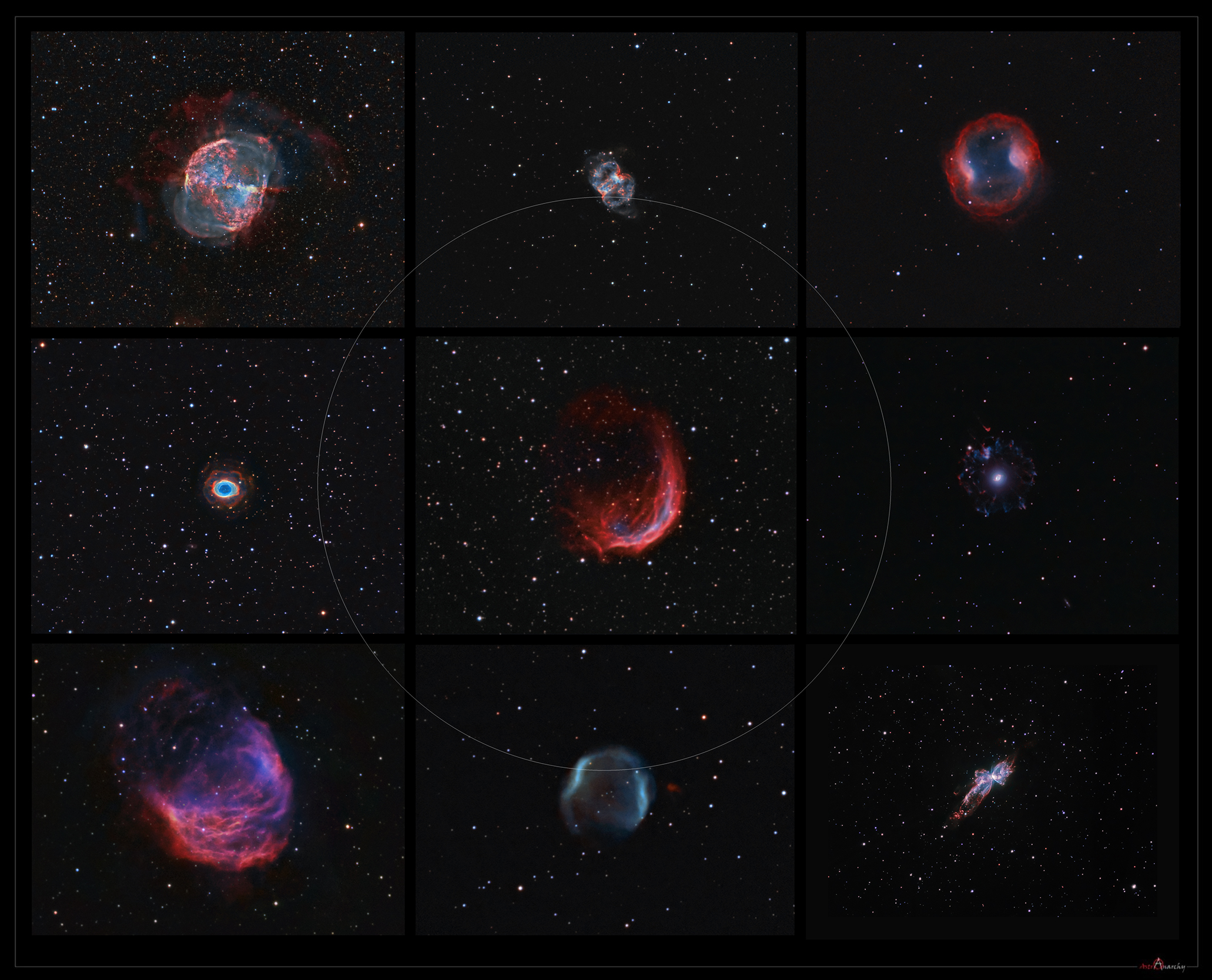
Planetary Nebula Project (18 Feb. 2011)
For my final APOD of this quarter I decided to go with something that we have been discussing in class once again and I also found the picture to be quite pleasing to the eyes. Here we see the end of star formation as the planetary nebulae. These gaseous objects are ionized by the extremely hot central core, the shrinking core of a star running out of fuel for nuclear fusion. In this compilation, nine nebulae are displayed for comparison in a 3x3 grid. The planetary nebulae being shown here are the bright Messier objects M27 - the Dumbbell Nebula, M76 - the Little Dumbbell, and M57 - the Ring Nebula, as well as NGC 6543, aka the Cat's Eye Nebula. Lesser known nebulae include the Medusa and the Bug. All the images were made with detailed narrow band data and are shown at the same angular scale, spanning 20 arc minutes (1/3 degree). At that scale, the grey circle represents the apparent size of the Full Moon. These planetary nebulae hint at the fate of our own Sun as its core runs out of nuclear fuel in another 5 billion years.
Friday, March 18, 2011
APOD 3.7
http://apod.nasa.gov/apod/ap110213.html

Ice Fishing for Cosmic Neutrinos (Feb. 13 2011)
This was intriguing to me because scientists are melting holes in the bottom of our world! In fact, almost 100 of these holes melted near the South Pole are being used as astronomical observatories. Astronomers with the IceCube Neutrino Observatory lowered into each hole a long string knotted with light detectors which are roughly the size of basketballs. The water in each hole soon refreezes. The detectors attached to the strings are sensitive to blue light emitted in the surrounding clear ice. Such light is expected by the astronomers from ice collisions with high-energy neutrinos emitted by objects or explosions out in the universe. Last year, the last of IceCube's 86 strings were lowered into the freezing abyss, pictured above, making IceCube the largest neutrino detector ever created. Data from a preliminary experiment, AMANDA, has already been used to create the first detailed map of the high-energy neutrino sky. Experimental goals of the newer IceCube include a search for cosmic sources of neutrinos, a search for neutrinos coincident with nearby supernova and distant gamma-ray bursts, and, if lucky, a probe of exotic physical concepts such as unseen spatial dimensions and faster-than-light travel.I felt this was a fitting APOD to what we are currently discussing so I decided to look into it. I personally find all the different methods of attempting to detect neutrinos as fascinating because they are so translucent.
Subscribe to:
Comments (Atom)