Tuesday, May 31, 2011

APOD 4.6

http://apod.nasa.gov/apod/ap110528.html


The Mileage of Light (May 28 2011)

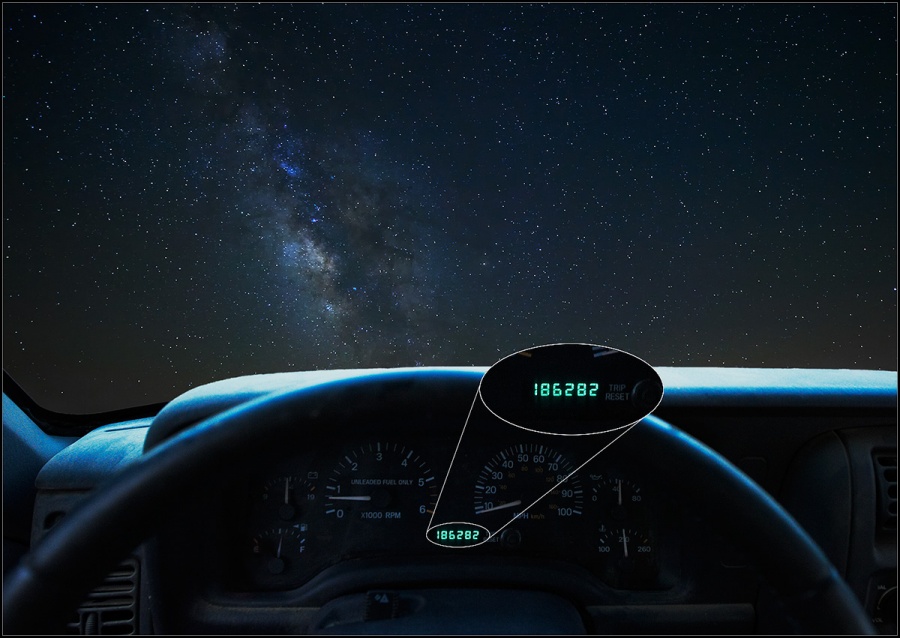
            While driving, the astronomer Dennis Mammana looked at his odometer and realized that it read 186,282 miles. If you don't already know, this is the number of miles light travels in one second. In Dennis' case, it took him about thirteen years to travel this distance. I thought that this was a good example of just how quickly light travels and how much the quantities within our universe vary from the smallest molecule to the largest super-massive black holes and so on. This also gives me an idea of how truly vast and extensive the universe is considering that some of the objects in the sky that we can observe don't exist anymore but the light is just reaching us. If it took light a long time to travel that distance, I don't even want to know how truly far away those objects are. I can not fathom it even if you put a number on it.

Friday, May 20, 2011

Biography - David Levy


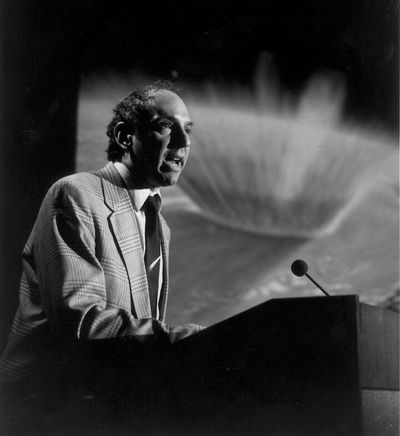
          David Levy is not only an astronomer but he is also a writer in the areas of science. Levy 
was born in MontrealQuebecCanada, on May 22, 1948. Despite having an interest in astronomy from an early age, he pursued and received bachelor’s and master’s degrees in English 
literature. In 1967 he almost got expelled from the Royal Astronomical Society of Canada's 
Montreal Centre after an argument with some members of its administration. "Levy will never 
amount to anything," one senior official of the RASC remarked in 1968. Years later, Levy began 
a correspondence with Isabel Williamson, the one that he started the quibble with. These 
letters turned into visits, the presentation of the National Service Award to Miss Williamson, and 
the naming of the Montreal Centre's Observatory after her. Levy went on to discover 22 comets, whether it was him alone or with her is uncertain. He has written 34 books, mostly on astronomical subjects, such as The Quest for Comets and his tribute to Gene Shoemaker in Shoemaker by Levy. He has provided periodic articles for Sky and Telescope magazine, as well as Parade MagazineSky News and Astronomy Magazine.
Periodic comets that Levy co-discovered include 118P/Shoemaker-Levy129P/Shoemaker-Levy, 135P/Shoemaker-Levy, 137P/Shoemaker-Levy, 138P/Shoemaker-Levy, 145P/Shoemaker-Levy, and 181P/Shoemaker-Levy. Levy is the sole discoverer of two periodic comets P/1991 L3 and P/2006T1. He was also the first to discover comets visually, photographically , and electronically, which I think is quite the impressive feat!
On February 28, 2010, Levy was awarded a Ph. D. from the Hebrew University of Jerusalem for his successful completion of his thesis "The Sky in Early Modern English Literature: A Study of Allusions to Celestial Events in Elizabethan and Jacobean Writing, 1572-1620."
At this point in his life, Levy lives in Vail, Arizona and is married to Wendee Levy. Levy and his wife host a weekly internet radio talk show on astronomy. Along with this he is also President of the National Sharing the Sky Foundation which seeks to promote intelligent awareness of astronomy and related sciences.

Friday, May 6, 2011

Zooniverse Update

Transits, transits, transits... one box surrounding one after another. Thats basically all there is to this project. You select the shape the star has, the variance of its pulses, and check for transits.

APOD 4.5

http://apod.nasa.gov/apod/ap110502.html


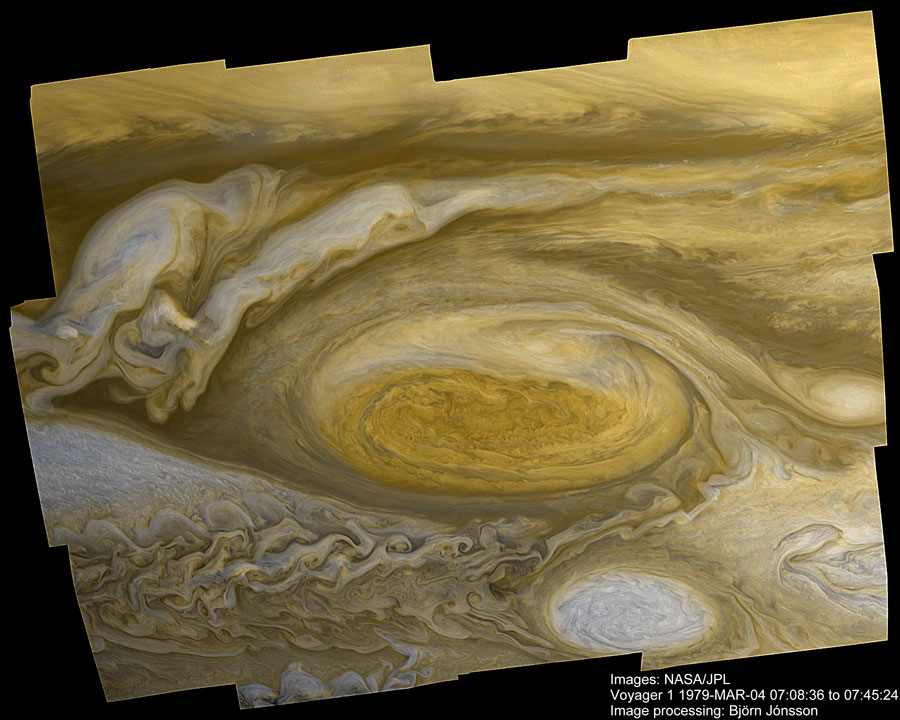
Jupiter's Great Red Spot from Voyager 1 (6 May 2011)

                Going on as long as we have had the capabilities of viewing Jupiter' s surface is a storm that is twice the size of Earth. In regards to our Solar System it is the largest storm of its sort. The spot was a sort of mystery directly after its discovery and still to this day details of how and why the storm changes its shape, color and size remain uncertain. The best way to understand its properties would be to compare it to the storms right here on Earth. The above image is a recently completed digital enhancement of an image of Jupiter taken in 1979 by the Voyager 1 spacecraft as it passed by Jupiter. At about 117AU from Earth, Voyager 1 is currently the most distant human made object in the universe and expected to leave the entire solar heliosheath relatively soon.

Tuesday, May 3, 2011

Zooniverse Update

As I have been working on the Planet Hunters project on Zooniverse, one thing has stood out to me that I particularly enjoy. This is the fact that once you locate what you believe are the transit features of the star, you can compare you results with those all over the globe and even enter a forum in which anyone participating can discuss their results and come a to a similar conclusion. I feel that this is helpful to anybody from a beginner like me to those more affluent with the subject because it creates areas of interest for any one person.

APOD 4.4

http://apod.nasa.gov/apod/ap110424.html


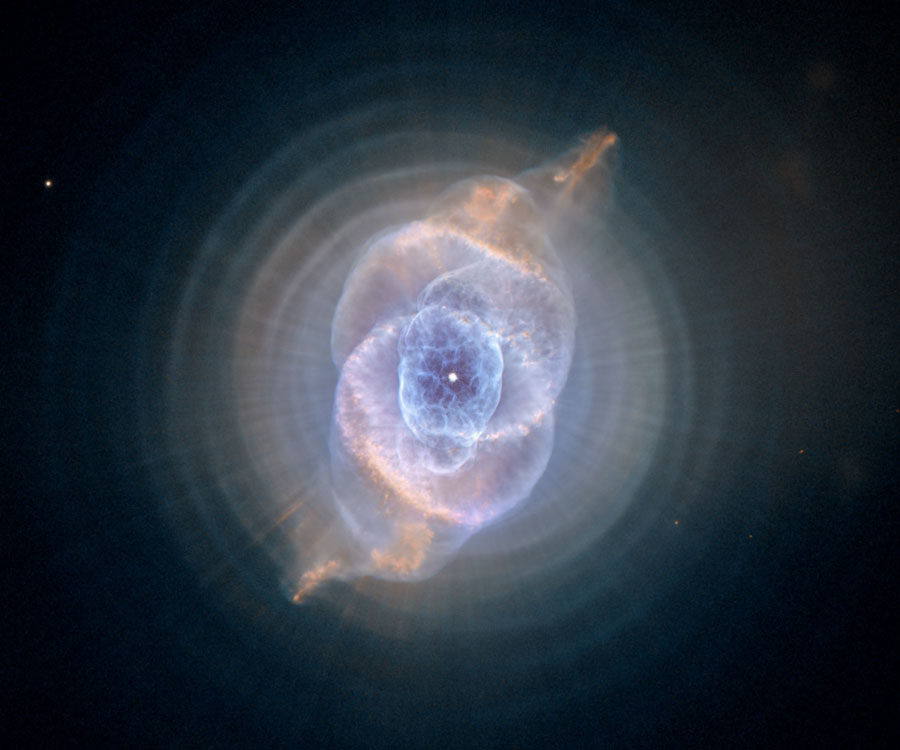
The Cat's Eye Nebula from Hubble (May 2 2011)

              For this APOD I went with probably my all time favorite Nebula, The Cat's Eye Nebula. The Cat's Eye Nebula lies about three thousand light years away from Earth. The phase of this nebula represents a final, brief but still impressive phase in the lifespan of a sun-like star. The nebula's withering central star may have produced the simple, outer pattern of dusty concentric figures by pushing away outer layers in a series of regular intervals. But the formation of the  more complex inner structures is not well understood. In this high resolution image produced by the Hubble Telescope, the Cat's Eye is about a half a light year across. This is such a huge distance which I believe that I will never have the opportunity of comprehending but in the grand scheme of things, it is minuscule. Astronomers believe that our sun will be in a similar phase as this one s currently in in about 5 billion years!

Friday, April 29, 2011

Zooniverse Update

So I got bored with the Hubble Project and have moved on to a new project once again. This one is titled Planet Hunters. With this project you are presented with information from the Kepler mission which uses the transit technique to detect exoplanets: terrestrial and larger planets orbiting other stars. With this method, planets that pass in front of their host stars block out some of the starlight causing the star to dim slightly for a few hours. The Kepler spacecraft stares at a field of stars in the Cygnus constellation and records the brightness of those stars every thirty minutes to search for transiting planets. All I really have to do is to mark a square around transit features in the scatter plots.

Thursday, April 28, 2011

APOD 4.3

http://apod.nasa.gov/apod/ap110425.html


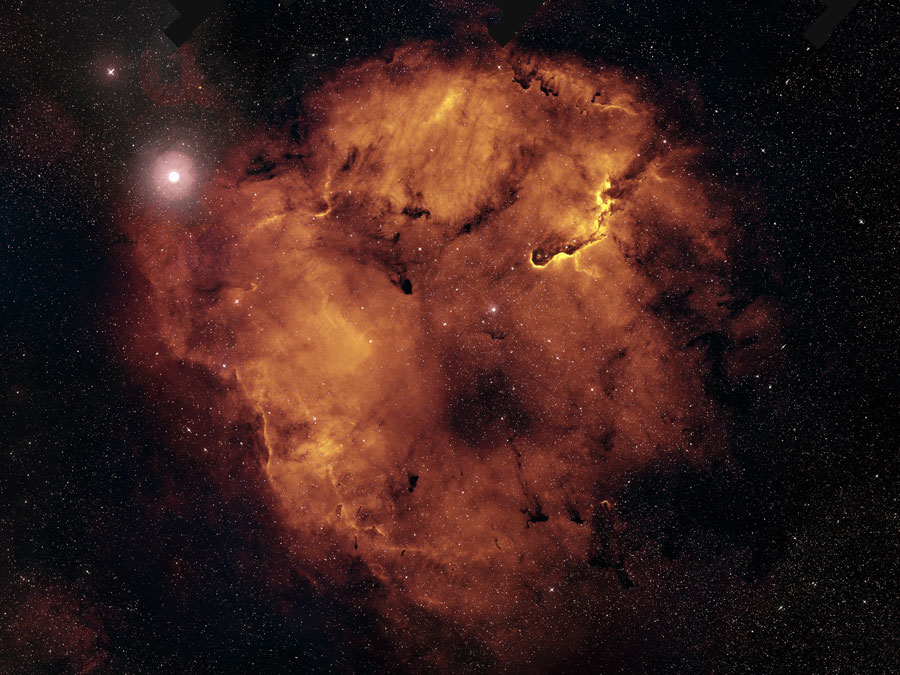
Monsters of IC 1396 (25 Apr 2011)

                  In this blog post I will be presenting you with information of IC 1396 which reminds me of a screaming baby. It is known to some as the Elephant's Trunk Nebula. Some of the glowing gas and dust clouds of this star formation region appear to take on several forms but in my opinion it looks very human-like The entire nebula might even look like a face of a monster. The only real monster here, however, is a bright young star too far from Earth to be dangerous. Energetic light from this star is eating away the dust of the dark cometary globule at the top right the image. Jets and winds of particles emitted from this star are also pushing away ambient gas and dust. Nearly 3,000 light-years distant, the IC 1396 complex is relatively faint and covers a region on the sky with an apparent width of more than 10 full moons.

Friday, April 15, 2011

APOD 4.2

http://apod.nasa.gov/apod/ap110414.html


Young Stars in the Rho Ophiuchi Cloud (Apr 15 2011)

                Coming from WISE, the Wide-field Infrared Survey Explorer, dust clouds and newborn stars glow at infrared wavelengths in this false-color photo. This portion of the cosmos contains on of the closest star forming regions, the Rho Ophiuchi cloud complex which is about 400 light-years from the constellation Ophiuchus. Once they have formed along a large cloud of cold molecular hydrogen gas, young stars heat the surrounding dust to produce a infrared glow. Stars which are being formed, called young stellar objects or YSOs, are embedded in the condensed pinkish nebulae seen here, but are otherwise hidden from view of optical telescopes. Delving deeper into the region of penetrating infrared light has detected emerging and newly formed stars whose average age is estimated to be a measly 300,000 years. That's relatively young compared to the Sun's age of 5 billion years. The prominent reddish nebula at the lower right surrounding the star Sigma Scorpii is a reflection nebula produced by dust scattering starlight.


Zooniverse Update

This week I have continued to work on Galaxy Zoo: Hubble. Throughout this week I have become more adept at discerning the specific features of galaxies such as bulges, spiral arms, etc. I feel as if I've determined enough galaxies at this point and plan on moving to something else. I did try the Old Weather project at first but the handwriting was difficult to read and I didn't want to enter incorrect data. 

Friday, April 8, 2011

Zooniverse

With the Zooniverse I have been working on the Galaxy Zoo: Hubble. This project uses hundreds of thousands of photos produced by NASA's Hubble Space Telescope. You are presented with a random photo and then it presents you with multiple queries about the galaxy or object such as its general shape and whether it has any features such as spirals or a central bulge. The interesting thing is that if you are quick, you may be the first person to have ever seen the image that pops up on your monitor.

APOD 4.1

http://apod.nasa.gov/apod/ap110328.html

http://vimeo.com/21294655

Time-Lapse Auroras Over Norway (Apr. 8 2011)

                    Above is posted a video which displays a time lapse of an aurora display in Kirkenes, Norway. An aurora is a natural light display in the sky, particularly in the polar regions, caused by the collision of charged particles directed by the Earth's magnetic field. They are usually observed at night and typically occur in the ionosphere. The chance of witnessing the aurora borealis increases with gained proximity to the North Magnetic Pole. Auroras seen near the magnetic pole may be high overhead, but from farther away, they tend to illuminate the northern horizon as a greenish glow or sometimes a faint red, sort of if like the Sun were rising from a different direction. The aurora borealis usually happens near the equinoxes. I thought that this video was really cool so I'd suggest checking it out if you haven't already. It was produced by Terje Sorgjerd over about a week's span.

Tuesday, March 29, 2011

Observation 4 - Astronomy Cast

For this observation I decided to listen to an Astronomy Cast and I went with episode 213 which pertains to super massive black holes. I can't deny that it was the title that drew me in, it just sounded rather intense and interesting. A few things I learned about these super massive black holes is that they are about a hundred million solar mass objects which lay at the center of galaxies. One noting this they discussed the physics of the black holes and the surrounding areas. Basically, its all the same physics you would find anywhere else in the galaxy its just on different scales such as increased rotation rates and different rates of material falling onto the inner body of the hole. After this they went on to discuss many more of the intricacies of these super massive black holes which I honestly can't quite restate in my own words because lets face it... it becomes quite complicated. Regardless, I still found the web cast to be astounding and was a good continuation of the video we watched in class.

Monday, March 28, 2011

Observation 3

This observation, like numerous others, occurred a couple weeks ago. This is because I have a tendency to forget to add my observations to my blog. I decided to go with my friend around 9 pm  to the park right down the street in Lake Sarasota. We laid out in an open field and just gazed at the stars for about an hour. I spent most of the time pointing out constellations and stars such as Orion and Ursa Major and giving some insight into the stories behind them. I also saw several shooting stars which is always an exciting occurrence for me.

Observation 2

On Saturday night, March 26, I went to astronomy night with members of this class and other interested individuals. At about 7pm you taught us how to properly use all of the equipment and what we should tell the other participants in case they were interested in using it. It started to get dark at about 8pm and so that is when I started gazing upon the skies. I first observed Sirius through the binoculars because it was the first star that I could see in the sky. I  saw many other things apart from this including Rigel, Betelgeuse, and Saturn. It was a great night for observations because the sky was clear and I didn't get drained by mosquitoes.

Thursday, March 24, 2011

APOD 3.8

http://apod.nasa.gov/apod/ap110218.html


Planetary Nebula Project (18 Feb. 2011)

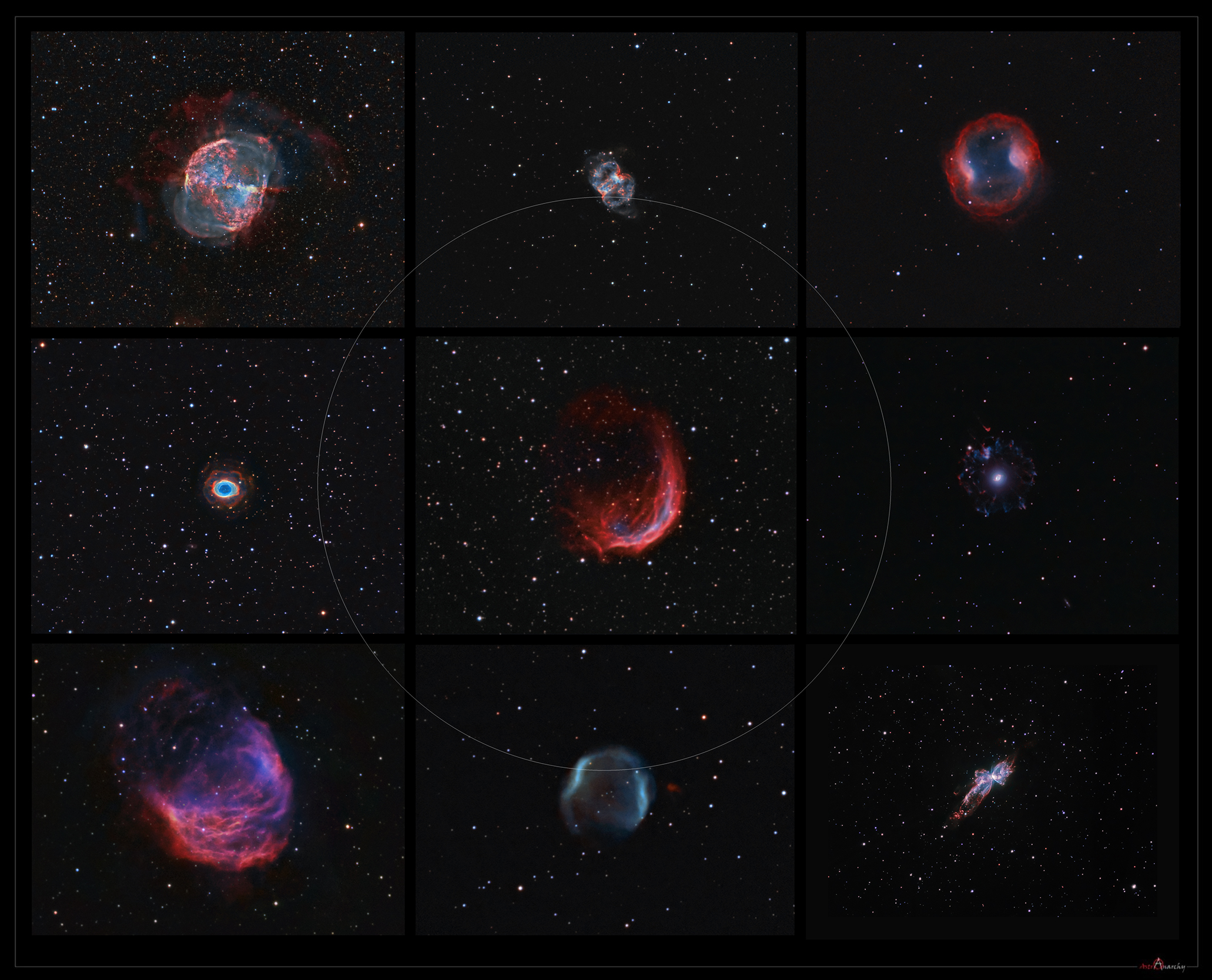
          For my final APOD of this quarter I decided to go with something that we have been discussing in class once again and I also found the picture to be quite pleasing to the eyes. Here we see the end of star formation as the planetary nebulae. These gaseous objects are ionized by the extremely hot central core, the shrinking core of a star running out of fuel for nuclear fusion. In this compilation, nine nebulae are displayed for comparison in a 3x3 grid. The planetary nebulae being shown here are the bright Messier objects M27 - the Dumbbell Nebula, M76 - the Little Dumbbell, and M57 - the Ring Nebula, as well as NGC 6543, aka the Cat's Eye Nebula. Lesser known nebulae include the Medusa and the Bug. All the images were made with detailed narrow band data and are shown at the same angular scale, spanning 20 arc minutes (1/3 degree). At that scale, the grey circle represents the apparent size of the Full Moon. These planetary nebulae hint at the fate of our own Sun as its core runs out of nuclear fuel in another 5 billion years. 

Friday, March 18, 2011

APOD 3.7

http://apod.nasa.gov/apod/ap110213.html


Ice Fishing for Cosmic Neutrinos  (Feb. 13 2011)

                   This was intriguing to me because scientists are melting holes in the bottom of our world! In fact, almost 100 of these holes melted near the South Pole are being used as astronomical observatories. Astronomers with the IceCube Neutrino Observatory lowered into each hole a long string knotted with light detectors which are roughly the size of basketballs. The water in each hole soon refreezes. The detectors attached to the strings are sensitive to blue light emitted in the surrounding clear ice. Such light is expected by the astronomers from ice collisions with high-energy neutrinos emitted by objects or explosions out in the universe. Last year, the last of IceCube's 86 strings were lowered into the freezing abyss, pictured above, making IceCube the largest neutrino detector ever created. Data from a preliminary experiment, AMANDA, has already been used to create the first detailed map of the high-energy neutrino sky. Experimental goals of the newer IceCube include a search for cosmic sources of neutrinos, a search for neutrinos coincident with nearby supernova and distant gamma-ray bursts, and, if lucky, a probe of exotic physical concepts such as unseen spatial dimensions and faster-than-light travel.I felt this was a fitting APOD to what we are currently discussing so I decided to look into it. I personally find all the different methods of attempting to detect neutrinos as fascinating because they are so translucent.


Friday, February 25, 2011

APOD 3.6

http://apod.nasa.gov/apod/ap110220.html


Mammatus Clouds (Feb. 20 2011)

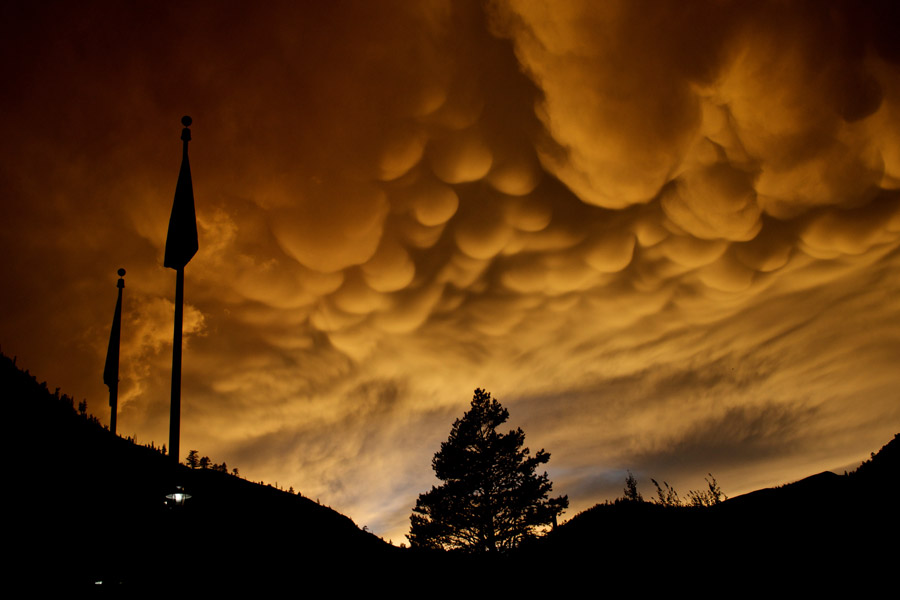
               Once viewing this photo I was blown away due to the fact that I had never seen clouds take this form before. Clouds usually appear to be flat because moist warm air that rises and cools will condense into water droplets at a very specific temperature, which usually corresponds to an equally as specific height. Once these water droplets form the air becomes opaque which is the cloud that we see. Under some conditions though, cloud pockets may develop which contain large droplets of water or ice that fall into clear air as they evaporate. Pockets of this kind may occur in turbulent air surrounding a thunderstorm, being seen near the top of an anvil cloud, for example. Anvil clouds are usually formed by upward columns of air that distort the middle and upper region of the clouds resulting in it's anvil like shape.  All of this is what leads to these Mammatus clouds being formed which looking stunning in the right lighting such as this photo.


Thursday, February 24, 2011

Biography: Edward Pickering


        Edward Pickering was an American physicist and astronomer who was born in Boston on the 19th of July in 1846. He graduated in 1865 from the Lawrence Scientific School of Harvard. Here, for the next two years, he was a teacher of mathematics. Afterwards he became a professor of physics at the Massachusetts Institute of Technology, and in 1876 he was given the position of professor of astronomy and director of the Harvard College observatory.


        In 1877 he made the choice to devote one of the telescopes of the observatory to stellar photometry, which I now know what it is thanks to our lab, and after he performed an exhaustive trial of various forms of photometers, he concocted the meridian photometer, which seemed to eliminate most of the factors that were causing error. What a meridian photometer is is as; an instrument in which mirrors are used to bring the light from two stars which are at or near the celestial meridian simultaneously, but at different altitudes, to a common focus, to compare their brightness. Using the fist instrument of this kind, having objectives of 1.5 inches aperture, he measured the brightness of 4260 stars, including all stars ascending to the 6th magnitude between the North Pole and -30° declination. With the objective of reaching fainter stars, Pickering constructed another instrument on a larger scale, and with this more than a million observations have been made. The first important work undertaken with it was a revision of the magnitudes given in the Bonn Durchmusterung. These were a series of astrometric star catalogues of the entire sky from the Bonn Observatory in Germany in the late 19th century leading into the 20th.


        Once he finished this, Pickering decided to undertake the surveying of the southern hemisphere. An expedition, under the direction of Prof. S. I. Bailey, was accordingly dispatched in 1889, allowing the meridian photometer to be erected successively in three different positions on the slopes of the Andes. The third of these locations was Arequipa, at which a permanent branch of the Harvard Observatory still stands to this day. The magnitudes of up to 8000 southern stars were determined, including 1428 stars of the 6th magnitude and brighter. The photometer was then shipped back to Cambridge, Massachusetts, where the survey was extended to include all stars of magnitude 7.5 all the way down to -40° declination, after which it was once again sent back to Arequipa. In 1886 the widow of Henry Draper, one of the pioneers of stellar spectroscopy, requested that spectroscopic investigations be continued at Harvard College in memory of her husband. With Pickering's profusion, the inquiry was so arranged as to cover the entire sky; and with four telescopes, two at Cambridge for the northern hemisphere, and two at Arequipa in Peru for the southern. Due to this up to 75,000 photographs had been obtained up to the beginning of 1901. These investigations have yielded numerous important discoveries including an entirely new class of double stars whose binary character is only revealed by peculiarities in their spectra.


           Edward Pickering died in Cambridge on February 3 in 1919. The cause of his death has not been specified.

Sources: Edward Pickering

  • "Edward Charles Pickering." NNDB: Tracking the Entire World. Web. 24 Feb. 2011. <http://www.nndb.com/people/940/000100640/>.
  • "The Bruce Medalists: Edward C. Pickering." SSU Department of Physics & Astronomy - Home. Web. 24 Feb. 2011. <http://www.phys-astro.sonoma.edu/BruceMedalists/Pickering/index.html>.
  • "Biography of Edward Pickering." Page Start-up. Web. 24 Feb. 2011. <http://astronomy.wakaf.net/htm/pickering.htm>
  • Miss Leavitt in Pickering, Edward C. "Periods of 25 Variable Stars in the Small Magellanic Cloud" Harvard College Observatory Circular 173 (1912) 1-3.

Tuesday, February 22, 2011

Observation

Sunday Feb 20 2011


During this observation session we where able to see


  • about 10 first magnitude stars including Betelgeuse and Rigel
  • all of the constellations visible in the sky at this time
  • and also some other miscellaneous objects such as m41 and m42  

Friday, February 18, 2011

APOD 3.5

http://apod.nasa.gov/apod/ap110130.html


Europa: Phases (Jan. 30 2011)

                   All of these phases of the moon look familiar to what we usually see in the night sky except for the the fact that this is Europa, one of Jupiter's moons. The robot spacecraft Galileo captured these images during one of its mission in which it orbited Jupiter from 1995 - 2003. The fluctuations that are visible are plains of bright ice, cracks that run to it's horizon, and dark patches that are believed to contain both ice and dirt. You can see raised terrain particularly visibly near the terminating end, where it casts shadows. Europa is nearly the same size as Earth's Moon, but much smoother, showing few highlands or large impact craters. Evidence and images from the Galileo spacecraft indicate that liquid oceans might exist below the icy surface which I find astounding and hope will allow them to find some new life form or elements. To test this speculation that the seas hold life, NASA and ESA (European Space Agency) have started preliminary development of the Europa Jupiter System Mission, a spacecraft proposed for launch around 2020 that will extensively explore Jupiter and in particular Europa. If the surface ice is thin enough, there is the possibility of a future mission that might drop hydrobots to burrow into the oceans and search for life. 

This is an artist's rendition of what the hydrobots might appear.


Monday, February 14, 2011

APOD 3.4


Rosette Nebula (14 Feb. 2011)

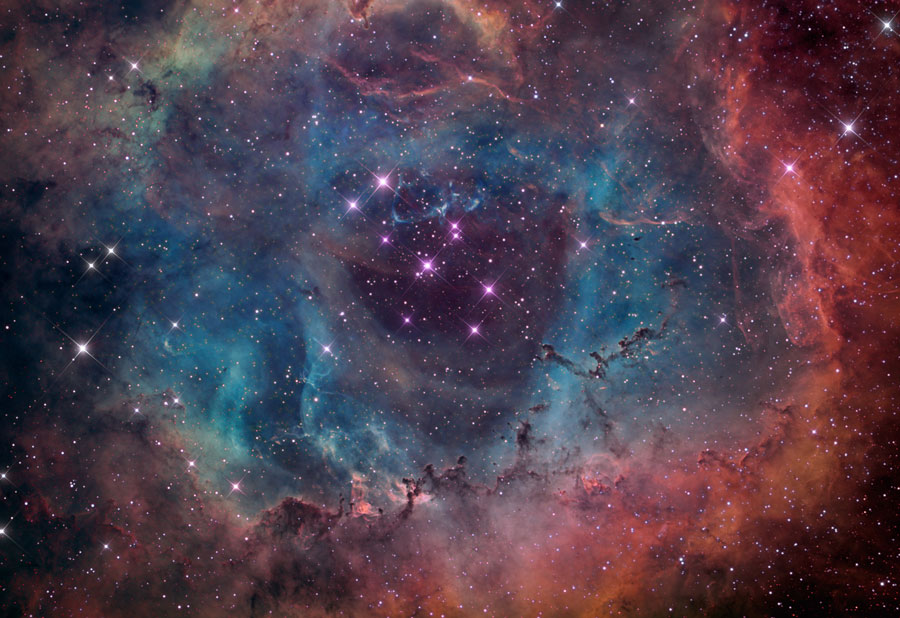
I chose to delve into this Nebula because we talked about it in class today and it is in the general direction of one of this week's constellations. The Rosette Nebula or, or more bland name NGC 2237, doesn't appear to diminish the appearance of this stunning emission nebula. The interior of the nebula contains an open cluster of bright young stars designated as NGC 2244. The majority of these stars formed about four million years ago from the nebular material and their stellar winds are creating quite an impressionable hole in the nebula's center, insulated by a layer of dust and hot gas. Ultraviolet light from the hot cluster stars causes the surrounding nebula to glow. The Rosette Nebula spans about 100 light-years across, is about 5000 light-years away, and can be seen with a small telescope if you look towards the constellation Monoceros.

Friday, February 4, 2011

APOD 3.3

http://apod.nasa.gov/apod/ap110204.html


Zeta Oph: Runaway Star  (4 Feb. 2011)

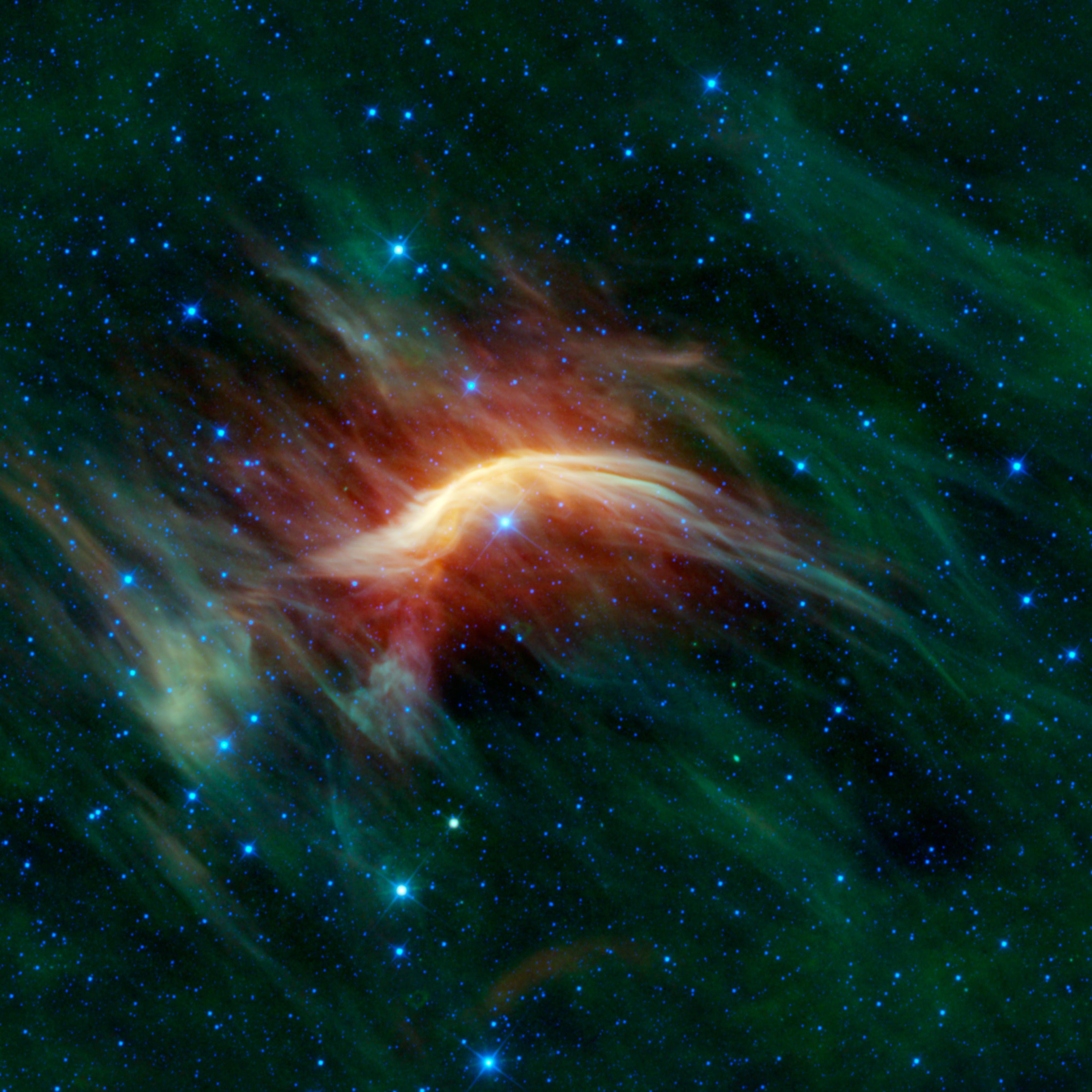
                    What to me looks like a wave crashing through the cosmos is in actuality the arcing interstellar bow wave or bow shock of the runaway star, Zeta Oph. This portrait comes from the WISE Spacecraft and was taken by infrared imaging. In this false-color view the bluish Zeta Oph is about twenty times more massive than the Sun and lying near the center of the frame, it is moving toward the top at twenty-four kilometers per second. It has strong stellar wind which precedes it, compressing and heating the dusty interstellar material and shaping the wave-like shock front. Around it are clouds of material that appears to be still or relatively calm compared to the bow wave. The reason why Zeta Oph is moving is because it was likely once a member of a binary star system but its companion star was larger and thus had a shorter lifespan. When the companion exploded as a supernova losing enormous amounts of mass, Zeta Oph was flung out of the binary system. At about 460 light-years away, Zeta Oph is 65,000 times more luminous than the Sun and would be one of the brightest stars if it weren't surrounded by so much dust. It's estimated distance is about twelve light years.


Friday, January 28, 2011

APOD 3.2

http://apod.nasa.gov/apod/ap110128.html


NanoSail-D (Jan. 28 2011)

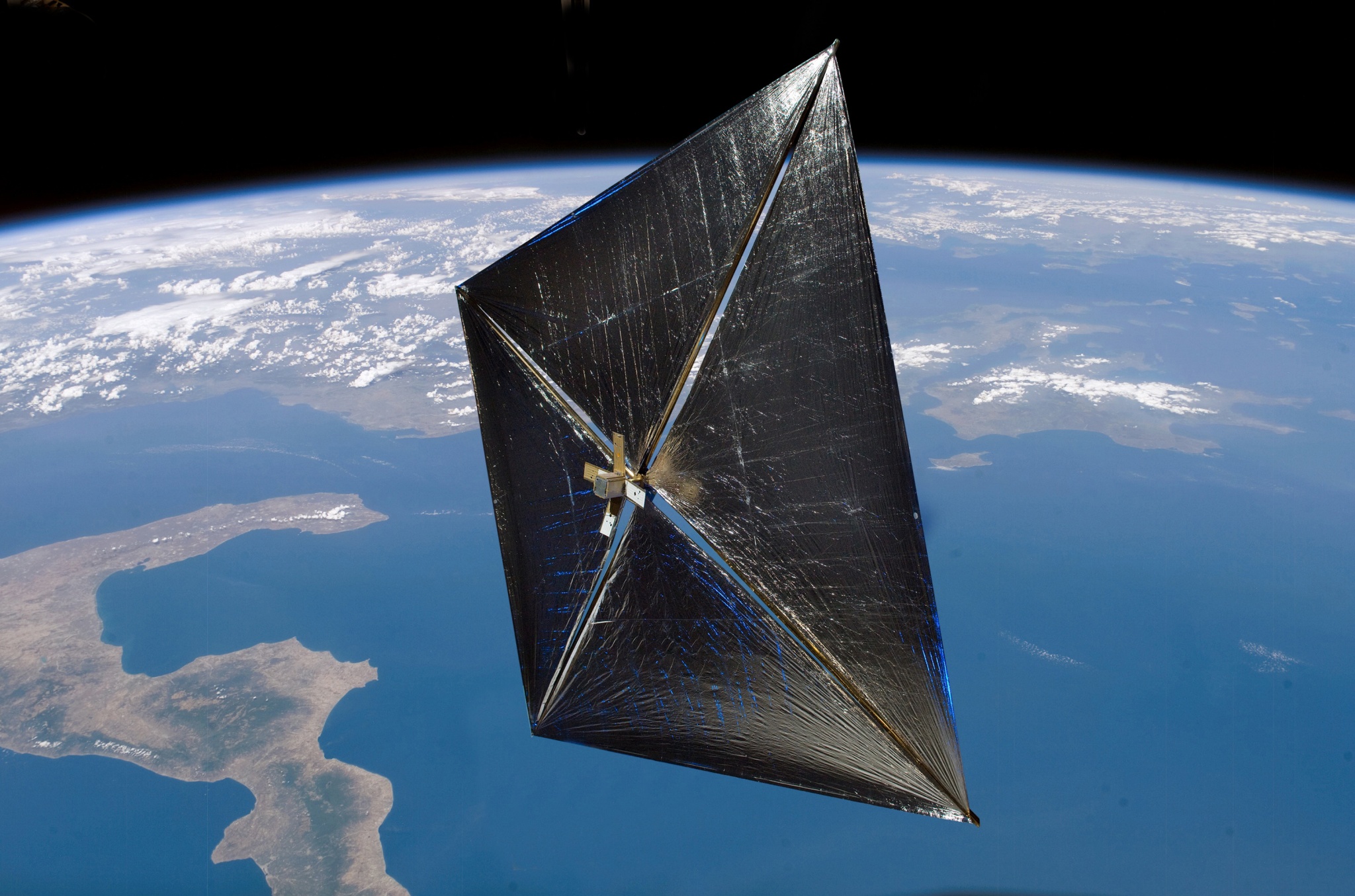
               Though this photo is only an artist's illustration, it still gives a realistic portrayal of NASA's NanoSail-D. The NanoSail-D has just unraveled a very thin, ten square meter reflective sail on January 20th, becoming the first solar sail spacecraft in low Earth orbit. Though to many people this has just been considered a far off dream, sailing through space was suggested about four hundred years ago by Johannes Kepler who observed comet tails blown by the solar wind. Modern solar sail spacecraft designs, like NanoSail-D or the Japanese interplanetary spacecraft IKAROS, rely on the minute but continuous pressure from sunlight itself for thrust. Glinting in the sunlight as it circles planet Earth, the NanoSail-D solar sail will periodically be bright enough to be easily visible to the naked eye. In fact, sky gazers are being urged to participate in an ongoing contest to capture images of the reflective sail. NASA stated that the images will help monitor the satellite before it reenters the atmosphere in April or May.


Friday, January 21, 2011

APOD 3.1


The Antikythera Mechanism (Jan. 9 2011)

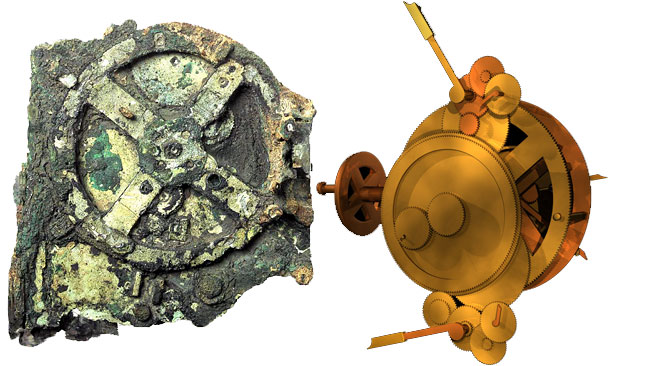
                     Looking at this one might ask what does this mechanism have to do with astronomy? In fact, it was found at the bottom of the sea within an ancient Greek ship. The apparent complexity of this mechanism has prompted decades of study, although some of its functions were still unknown. Recent X-ray scans of the device have now revealed the purpose of the Antikythera mechanism, and discovered several surprising functions. The Antikythera mechanism ascertains to be a mechanical computer of a level of accuracy thought impossible in 80 BC, when the ship that carried it sunk. Such sophisticated technology was not thought to be developed by humanity for another thousand years. Its wheels and gears create a portable orrery of the sky that predicted star and planet locations as well as lunar and solar eclipses in a heliocentric model. The mechanism, shown above, is thirty-three centimeters high so it is similar to the size of a text book. 

Friday, January 14, 2011

Observations 4

Astronomy Cast - Ep. 165: The Doppler Effect


                   Have you ever experience something like an ambulance driving past you and noticed that the sound changes? That’s the Doppler effect in work. It applies to both sound waves and light waves. Astronomers use the Doppler effect to study the motion of objects across the Universe, including nearby extra-solar planets to the numerous distant galaxies. Doppler shift is the change in length of a wave (light, sound, etc.) due to the relative motion of source and receiver. Things moving toward you have their wavelengths shortened. Things moving away have their emitted wavelengths lengthened. For waves that multiply in a medium, such as sound waves, the velocity of the observer and of the source are relative to the medium in which the waves are transmitted. The total Doppler effect may therefore result from motion of the source, motion of the observer, or motion of the medium. Each of these effects is analyzed separately. For waves which do not require a medium, such as light or gravity in general relativity, only the relative difference in velocity between the observer and the source needs to be considered.


APOD 2.8


A Sun Halo Beyond Stockholm (Jan 10, 2011)

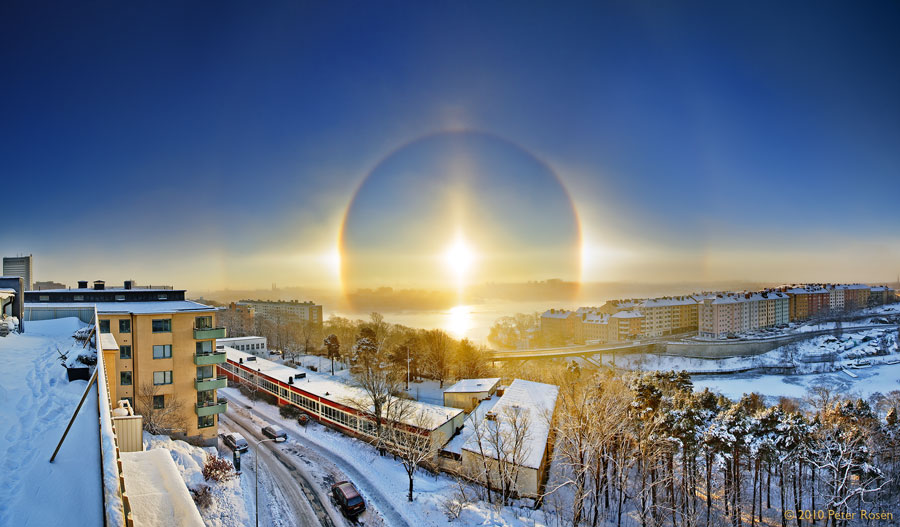
                  When looking at this picture you might wonder what exactly is going on and why does the sun look like this? This image makes it seem as if there is some effect or distorted lenses. What gives it this effect is millions and millions of ice crystals which serve as a sort of lenses. When water freezes in the upper atmosphere, small, flat, six-sided, ice crystals can often be formed. When these ice crystals falling to the ground, much of the trip spent with their faces flat, parallel to the ground. An observer may pass through the same plane as many of the falling ice crystals near sunrise or sunset. Due to this alignment, each crystal can act like a natural lens, refracting sunlight into our view and creating phenomena like parhelia, which is the technical term for sundogs. The sundog is the effect you are seeing in the above image. This image was taken last year in Stockholm, Sweden and in the center of the image is the Sun, while two bright sundogs glow prominently from both the left and the right. Also visible is the bright 22 degree halo, as well as the much less common 46 degree halo, also created by sunlight reflecting off the atmospheric ice crystals.

Tuesday, January 11, 2011

Biography: Pierre Méchain

Pierre Méchain


              Pierre Méchain was born August 16, 1744 in Laon, France. He was the son of Pierre-François Méchain, who was an architect, and Marie-Marguerite Roze, and early in his life wanted to follow his father in a career in architecture. He studied mathematics and physics, but due to financial difficulties he ended up leaving college. He then became friends with Jérôme de Lalande, who allowed him to proof-read parts of the second edition of his book, L'Astronomie. In 1772, Lalande got Méchain a position as an assistant hydrographer at the Depot of Maps and Charts of the Navy in Versailles. In 1774, Méchain became the calculator with the Depot of the Navy. Then he met Charles Messier, who worked for the same department, but at the smaller observatory at the Hôtel de Clugny. Around this time they became friends and began to work together occasionally. Méchain was first involved in surveys of the French coastline. He also occasionally had to make observations at Versailles. Later in 1774, he observed an occultation of Aldebaran by the Moon, which he later presented as a memoir to the Academy of Sciences. To give one a figure of how big Aldebaran is, imagine our Sun but forty times as wide.


In 1777, Méchain married Barbe-Thérèse Marjou whom he met while working in Versailles. They had two sons: Jérôme, and Augustin, and one daughter who's name I did not find.
Like Messier, Méchain became extremely devoted to comet observing and discovering new ones. He also started to stumble upon nebulous objects, and between 1779 and 1782, discovered a considerable number of thirty deep sky objects, twenty six of which were first discovered by him. He almost instantly discussed his observations with Charles Messier, who usually checked their positions and added them to his catalog. Both astronomers undertook a vigorous effort to find more nebulae between late August 1780 and March 1781, when the manuscript for the final version of the Messier catalog was sent out to print. Méchain's last two contributions, M102 and M103, went into the publication unchecked and without positions. Four other findings missed the publication; these are now known as M104, M105, M106, and M107. He sent them to Bernoulli, the editor of the Berliner Astronomisches Jahrbuch at the time. Since these four objects were not contained in the original Messier catalog, they were attributed separately to Pierre Méchain, John Herschel, and J.L.E. Dreyer. In this same letter, Méchain disclaimed his discovery of M102 as an erroneous re-observation of M101, thereby initiating a still open discussion on the true founder of this object.
In this letter he also mentioned the objects listed in Messier's catalog with M97 which are now recognized as M108 and M109 after their addition proposed by Owen Gingerich. Moreover, Pierre Méchain stated to have observed some more nebulae in the region of the Virgo Cluster which Messier had not included in his catalog, but unfortunately he did not give any credit to Méchain for this discovery.


Méchain discovered his first two comets in 1781, and because of his mathematical skills, he was able to calculate their orbits. In particular, he investigated the orbits of the comets of 1532 and 1661, and disproved the common hypothesis at the time that these were the same object. This work won the Grand Prix of 1782 of the Academy of Sciences, and was the main reason that he became a member of the Academy of Sciences in 1782. During the 1780s, Méchain began numerous surveys to produce maps of Germany and Northern Italy. In 1785, Pierre Méchain became editor of the Connoissance des Temps, the journal which had published the Messier Catalog. Méchain was principle editor of the Connoissance des Temps from 1788 to 1794. In 1787, Méchain collaborated with J.D. Cassini and Legendre on measuring the accurate longitude difference between Paris and Greenwich. At this time all three visited William Herschel at his observatory in Slough, England.


In 1791, Méchain undertook the southern part of a new survey of the meridian from Dunkirk to Barcelona, together with an assistant, Tranchot. The operation began in June 25, 1792, suffering from various obstacles from the French revolution: For example, Méchain and Tranchot got arrested by revolutioneers in Essone, who first mistook their telescopes as weapons, but eventually freed them. Shortly after this, war broke out between France and Spain, and he unfortunately was drafted into the war. Nevertheless, he discovered another comet, his 7th, from Barcelona on January 10, 1793. During the terror regime in Paris, while he was away, all of his property was confiscated, and his family suffered immensely. Once he returned, he became a member of the new Academy of Sciences, and the Bureau of Longitudes. Moreover, he was made director of the Paris Observatory, where he discovered his 8th and last comet on December 26, 1799; he also received help from Messier to find its orbit. Unfortunately shortly after this discovery, Pierre Méchain caught yellow fever and died in Castillion de la Plana in Spain on September 20, 1804.

Friday, January 7, 2011

APOD 2.7


Light Everywhere (7 Jan. 2011)

             What is being shown in this photograph is the hundreds of billions of stars within the vast Milky Way. What I found most interesting about this photo was actually the process of taking the photo and making it as you see now. This is because along with many other things, photography is a large part of astronomy because what can't be explained through words and facts can be more easily explained through a photograph. This photograph is a panorama made with eight sets of five photos at eight seconds each. Much exposure was required for the galaxy so the foreground of course is a bit overexposed. Also the shooting star that you see required about fifty different shots. I believe it is important not only to praise the astronomers for all they have discovered about our vast universe but also the photographers and artists who are able to put the astronomer's vision into a sort of reality.

Biography Sources - Pierre Méchain

  • Connor, J.J. O' "Mechain Biography." MacTutor History of Mathematics. Web. 6 Jan. 2011.       <http://www-history.mcs.st-and.ac.uk/Biographies/Mechain.html>.
  •  Frommert, Hartmut. "Pierre Méchain (1744-1804)." SEDS. 19 May 2009. Web. 6 Jan. 2011. <http://seds.org/messier/xtra/history/pmechain.html>.
  • Kenneth Glyn Jones, 1991. Messier's Nebulae and Star Clusters. 2nd ed, Cambridge University Press, p. 335-6. 6 Jan. 2011
  • OPTCorp. "Méchain, Pierre François André - OPT Telescopes." Meade Telescopes, Celestron Telescopes and Telescope Accessories - OPT Telescopes. Web. 6 Jan. 2011. <http://www.optcorp.com/edu/articleDetailEDU.aspx?aid=2446>.