Friday, April 29, 2011
Zooniverse Update
So I got bored with the Hubble Project and have moved on to a new project once again. This one is titled Planet Hunters. With this project you are presented with information from the Kepler mission which uses the transit technique to detect exoplanets: terrestrial and larger planets orbiting other stars. With this method, planets that pass in front of their host stars block out some of the starlight causing the star to dim slightly for a few hours. The Kepler spacecraft stares at a field of stars in the Cygnus constellation and records the brightness of those stars every thirty minutes to search for transiting planets. All I really have to do is to mark a square around transit features in the scatter plots.

Thursday, April 28, 2011
APOD 4.3
http://apod.nasa.gov/apod/ap110425.html
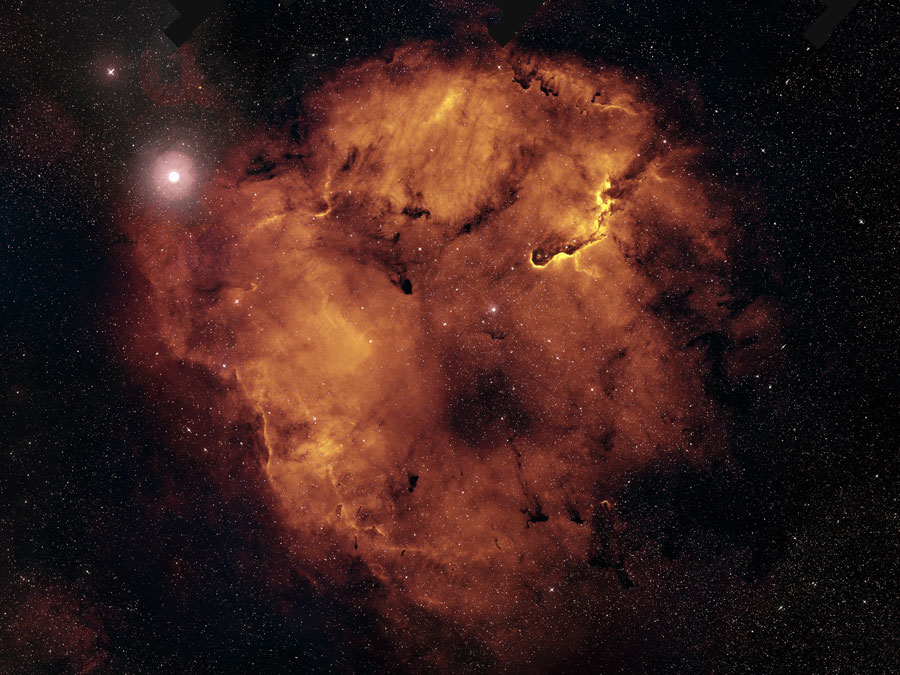
Monsters of IC 1396 (25 Apr 2011)
In this blog post I will be presenting you with information of IC 1396 which reminds me of a screaming baby. It is known to some as the Elephant's Trunk Nebula. Some of the glowing gas and dust clouds of this star formation region appear to take on several forms but in my opinion it looks very human-like The entire nebula might even look like a face of a monster. The only real monster here, however, is a bright young star too far from Earth to be dangerous. Energetic light from this star is eating away the dust of the dark cometary globule at the top right the image. Jets and winds of particles emitted from this star are also pushing away ambient gas and dust. Nearly 3,000 light-years distant, the IC 1396 complex is relatively faint and covers a region on the sky with an apparent width of more than 10 full moons.
Friday, April 15, 2011
APOD 4.2
http://apod.nasa.gov/apod/ap110414.html
Young Stars in the Rho Ophiuchi Cloud (Apr 15 2011)
Coming from WISE, the Wide-field Infrared Survey Explorer, dust clouds and newborn stars glow at infrared wavelengths in this false-color photo. This portion of the cosmos contains on of the closest star forming regions, the Rho Ophiuchi cloud complex which is about 400 light-years from the constellation Ophiuchus. Once they have formed along a large cloud of cold molecular hydrogen gas, young stars heat the surrounding dust to produce a infrared glow. Stars which are being formed, called young stellar objects or YSOs, are embedded in the condensed pinkish nebulae seen here, but are otherwise hidden from view of optical telescopes. Delving deeper into the region of penetrating infrared light has detected emerging and newly formed stars whose average age is estimated to be a measly 300,000 years. That's relatively young compared to the Sun's age of 5 billion years. The prominent reddish nebula at the lower right surrounding the star Sigma Scorpii is a reflection nebula produced by dust scattering starlight.
Zooniverse Update
This week I have continued to work on Galaxy Zoo: Hubble. Throughout this week I have become more adept at discerning the specific features of galaxies such as bulges, spiral arms, etc. I feel as if I've determined enough galaxies at this point and plan on moving to something else. I did try the Old Weather project at first but the handwriting was difficult to read and I didn't want to enter incorrect data.
Friday, April 8, 2011
Zooniverse
With the Zooniverse I have been working on the Galaxy Zoo: Hubble. This project uses hundreds of thousands of photos produced by NASA's Hubble Space Telescope. You are presented with a random photo and then it presents you with multiple queries about the galaxy or object such as its general shape and whether it has any features such as spirals or a central bulge. The interesting thing is that if you are quick, you may be the first person to have ever seen the image that pops up on your monitor.
APOD 4.1
http://apod.nasa.gov/apod/ap110328.html
http://vimeo.com/21294655
Time-Lapse Auroras Over Norway (Apr. 8 2011)
Above is posted a video which displays a time lapse of an aurora display in Kirkenes, Norway. An aurora is a natural light display in the sky, particularly in the polar regions, caused by the collision of charged particles directed by the Earth's magnetic field. They are usually observed at night and typically occur in the ionosphere. The chance of witnessing the aurora borealis increases with gained proximity to the North Magnetic Pole. Auroras seen near the magnetic pole may be high overhead, but from farther away, they tend to illuminate the northern horizon as a greenish glow or sometimes a faint red, sort of if like the Sun were rising from a different direction. The aurora borealis usually happens near the equinoxes. I thought that this video was really cool so I'd suggest checking it out if you haven't already. It was produced by Terje Sorgjerd over about a week's span.
Subscribe to:
Comments (Atom)