Friday, February 25, 2011

APOD 3.6

http://apod.nasa.gov/apod/ap110220.html
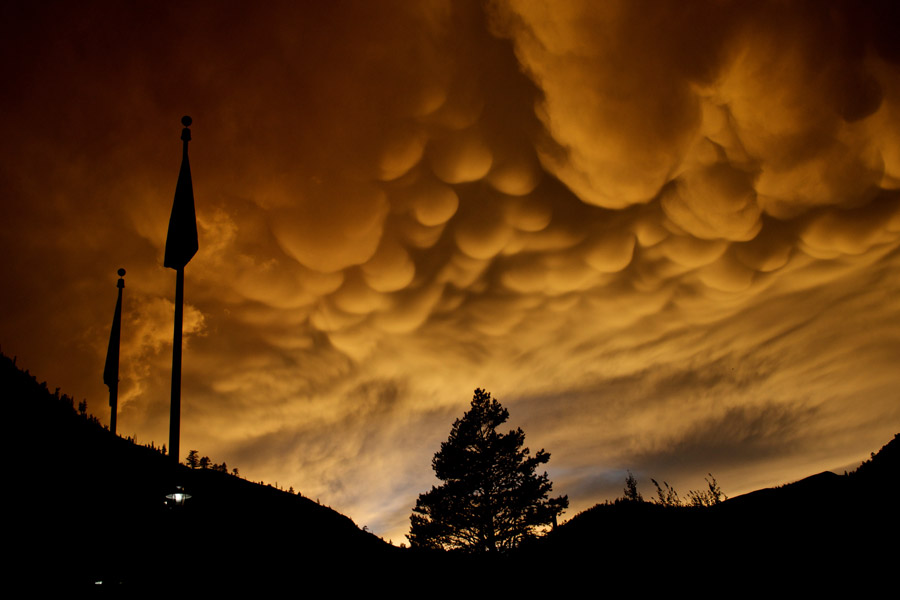

Mammatus Clouds (Feb. 20 2011)

               Once viewing this photo I was blown away due to the fact that I had never seen clouds take this form before. Clouds usually appear to be flat because moist warm air that rises and cools will condense into water droplets at a very specific temperature, which usually corresponds to an equally as specific height. Once these water droplets form the air becomes opaque which is the cloud that we see. Under some conditions though, cloud pockets may develop which contain large droplets of water or ice that fall into clear air as they evaporate. Pockets of this kind may occur in turbulent air surrounding a thunderstorm, being seen near the top of an anvil cloud, for example. Anvil clouds are usually formed by upward columns of air that distort the middle and upper region of the clouds resulting in it's anvil like shape.  All of this is what leads to these Mammatus clouds being formed which looking stunning in the right lighting such as this photo.


Thursday, February 24, 2011

Biography: Edward Pickering


        Edward Pickering was an American physicist and astronomer who was born in Boston on the 19th of July in 1846. He graduated in 1865 from the Lawrence Scientific School of Harvard. Here, for the next two years, he was a teacher of mathematics. Afterwards he became a professor of physics at the Massachusetts Institute of Technology, and in 1876 he was given the position of professor of astronomy and director of the Harvard College observatory.


        In 1877 he made the choice to devote one of the telescopes of the observatory to stellar photometry, which I now know what it is thanks to our lab, and after he performed an exhaustive trial of various forms of photometers, he concocted the meridian photometer, which seemed to eliminate most of the factors that were causing error. What a meridian photometer is is as; an instrument in which mirrors are used to bring the light from two stars which are at or near the celestial meridian simultaneously, but at different altitudes, to a common focus, to compare their brightness. Using the fist instrument of this kind, having objectives of 1.5 inches aperture, he measured the brightness of 4260 stars, including all stars ascending to the 6th magnitude between the North Pole and -30° declination. With the objective of reaching fainter stars, Pickering constructed another instrument on a larger scale, and with this more than a million observations have been made. The first important work undertaken with it was a revision of the magnitudes given in the Bonn Durchmusterung. These were a series of astrometric star catalogues of the entire sky from the Bonn Observatory in Germany in the late 19th century leading into the 20th.


        Once he finished this, Pickering decided to undertake the surveying of the southern hemisphere. An expedition, under the direction of Prof. S. I. Bailey, was accordingly dispatched in 1889, allowing the meridian photometer to be erected successively in three different positions on the slopes of the Andes. The third of these locations was Arequipa, at which a permanent branch of the Harvard Observatory still stands to this day. The magnitudes of up to 8000 southern stars were determined, including 1428 stars of the 6th magnitude and brighter. The photometer was then shipped back to Cambridge, Massachusetts, where the survey was extended to include all stars of magnitude 7.5 all the way down to -40° declination, after which it was once again sent back to Arequipa. In 1886 the widow of Henry Draper, one of the pioneers of stellar spectroscopy, requested that spectroscopic investigations be continued at Harvard College in memory of her husband. With Pickering's profusion, the inquiry was so arranged as to cover the entire sky; and with four telescopes, two at Cambridge for the northern hemisphere, and two at Arequipa in Peru for the southern. Due to this up to 75,000 photographs had been obtained up to the beginning of 1901. These investigations have yielded numerous important discoveries including an entirely new class of double stars whose binary character is only revealed by peculiarities in their spectra.


           Edward Pickering died in Cambridge on February 3 in 1919. The cause of his death has not been specified.

Sources: Edward Pickering

  • "Edward Charles Pickering." NNDB: Tracking the Entire World. Web. 24 Feb. 2011. <http://www.nndb.com/people/940/000100640/>.
  • "The Bruce Medalists: Edward C. Pickering." SSU Department of Physics & Astronomy - Home. Web. 24 Feb. 2011. <http://www.phys-astro.sonoma.edu/BruceMedalists/Pickering/index.html>.
  • "Biography of Edward Pickering." Page Start-up. Web. 24 Feb. 2011. <http://astronomy.wakaf.net/htm/pickering.htm>
  • Miss Leavitt in Pickering, Edward C. "Periods of 25 Variable Stars in the Small Magellanic Cloud" Harvard College Observatory Circular 173 (1912) 1-3.

Tuesday, February 22, 2011

Observation

Sunday Feb 20 2011


During this observation session we where able to see


  • about 10 first magnitude stars including Betelgeuse and Rigel
  • all of the constellations visible in the sky at this time
  • and also some other miscellaneous objects such as m41 and m42  

Friday, February 18, 2011

APOD 3.5

http://apod.nasa.gov/apod/ap110130.html


Europa: Phases (Jan. 30 2011)

                   All of these phases of the moon look familiar to what we usually see in the night sky except for the the fact that this is Europa, one of Jupiter's moons. The robot spacecraft Galileo captured these images during one of its mission in which it orbited Jupiter from 1995 - 2003. The fluctuations that are visible are plains of bright ice, cracks that run to it's horizon, and dark patches that are believed to contain both ice and dirt. You can see raised terrain particularly visibly near the terminating end, where it casts shadows. Europa is nearly the same size as Earth's Moon, but much smoother, showing few highlands or large impact craters. Evidence and images from the Galileo spacecraft indicate that liquid oceans might exist below the icy surface which I find astounding and hope will allow them to find some new life form or elements. To test this speculation that the seas hold life, NASA and ESA (European Space Agency) have started preliminary development of the Europa Jupiter System Mission, a spacecraft proposed for launch around 2020 that will extensively explore Jupiter and in particular Europa. If the surface ice is thin enough, there is the possibility of a future mission that might drop hydrobots to burrow into the oceans and search for life. 

This is an artist's rendition of what the hydrobots might appear.


Monday, February 14, 2011

APOD 3.4


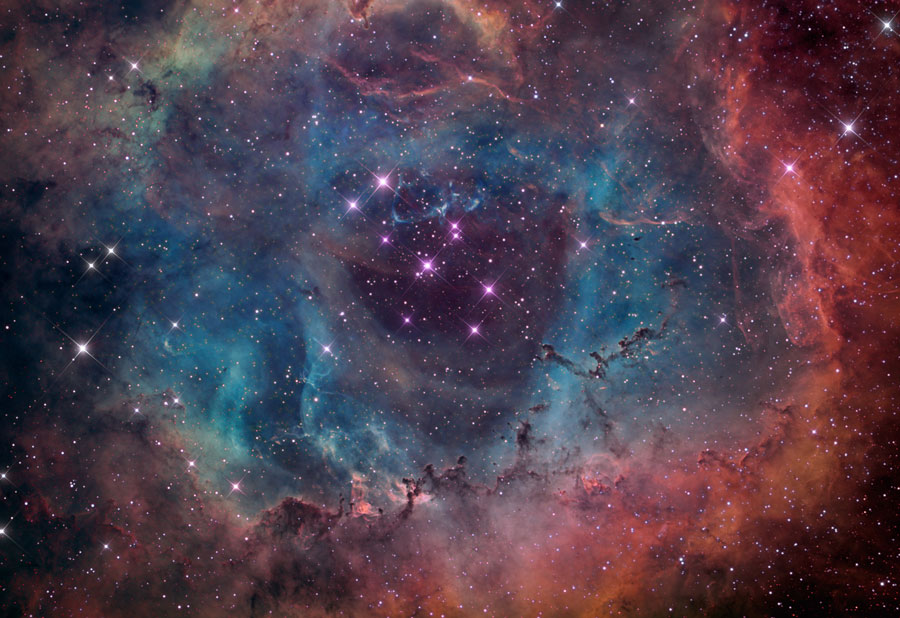
Rosette Nebula (14 Feb. 2011)

I chose to delve into this Nebula because we talked about it in class today and it is in the general direction of one of this week's constellations. The Rosette Nebula or, or more bland name NGC 2237, doesn't appear to diminish the appearance of this stunning emission nebula. The interior of the nebula contains an open cluster of bright young stars designated as NGC 2244. The majority of these stars formed about four million years ago from the nebular material and their stellar winds are creating quite an impressionable hole in the nebula's center, insulated by a layer of dust and hot gas. Ultraviolet light from the hot cluster stars causes the surrounding nebula to glow. The Rosette Nebula spans about 100 light-years across, is about 5000 light-years away, and can be seen with a small telescope if you look towards the constellation Monoceros.

Friday, February 4, 2011

APOD 3.3

http://apod.nasa.gov/apod/ap110204.html


Zeta Oph: Runaway Star  (4 Feb. 2011)

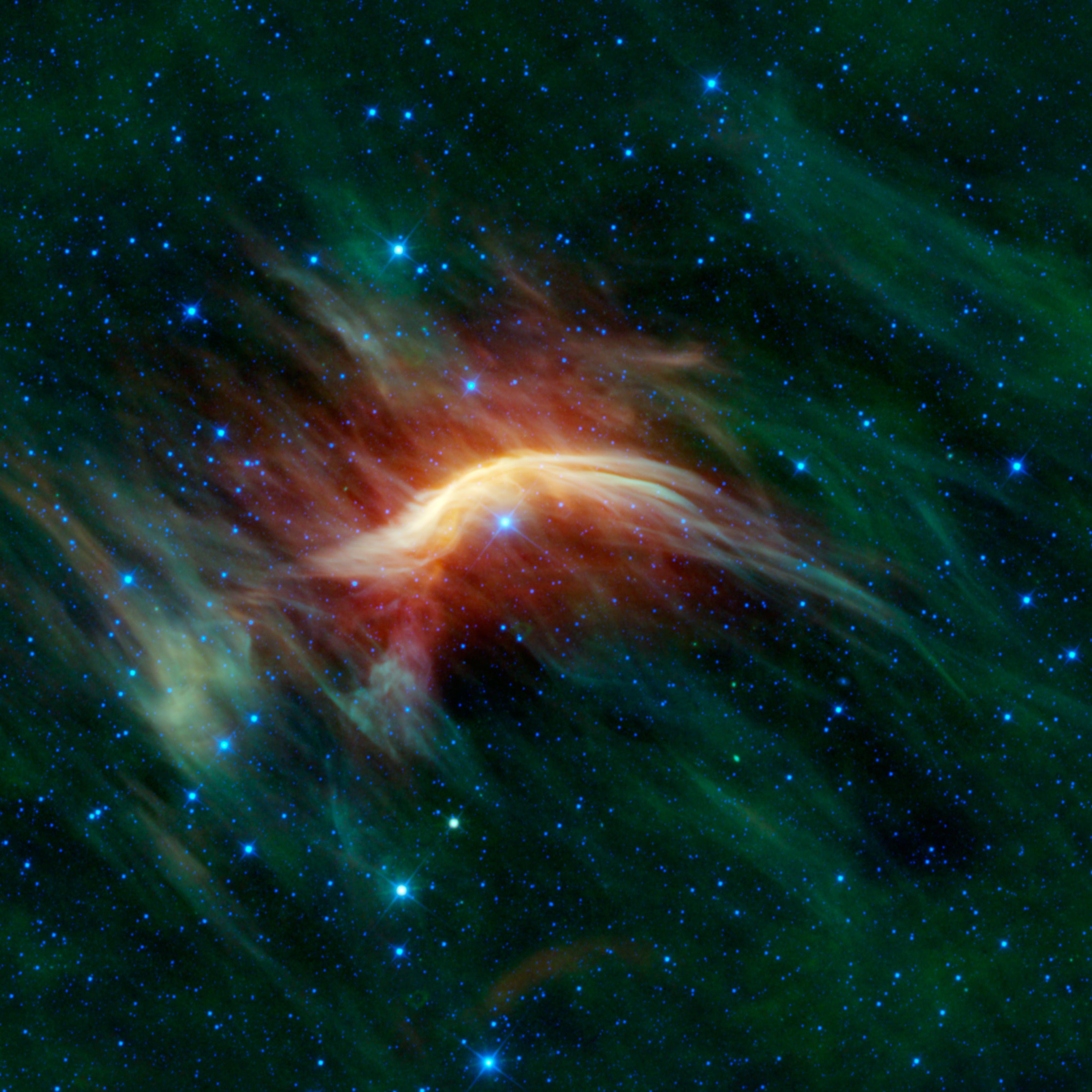
                    What to me looks like a wave crashing through the cosmos is in actuality the arcing interstellar bow wave or bow shock of the runaway star, Zeta Oph. This portrait comes from the WISE Spacecraft and was taken by infrared imaging. In this false-color view the bluish Zeta Oph is about twenty times more massive than the Sun and lying near the center of the frame, it is moving toward the top at twenty-four kilometers per second. It has strong stellar wind which precedes it, compressing and heating the dusty interstellar material and shaping the wave-like shock front. Around it are clouds of material that appears to be still or relatively calm compared to the bow wave. The reason why Zeta Oph is moving is because it was likely once a member of a binary star system but its companion star was larger and thus had a shorter lifespan. When the companion exploded as a supernova losing enormous amounts of mass, Zeta Oph was flung out of the binary system. At about 460 light-years away, Zeta Oph is 65,000 times more luminous than the Sun and would be one of the brightest stars if it weren't surrounded by so much dust. It's estimated distance is about twelve light years.