Sunday, December 12, 2010

APOD 2.6


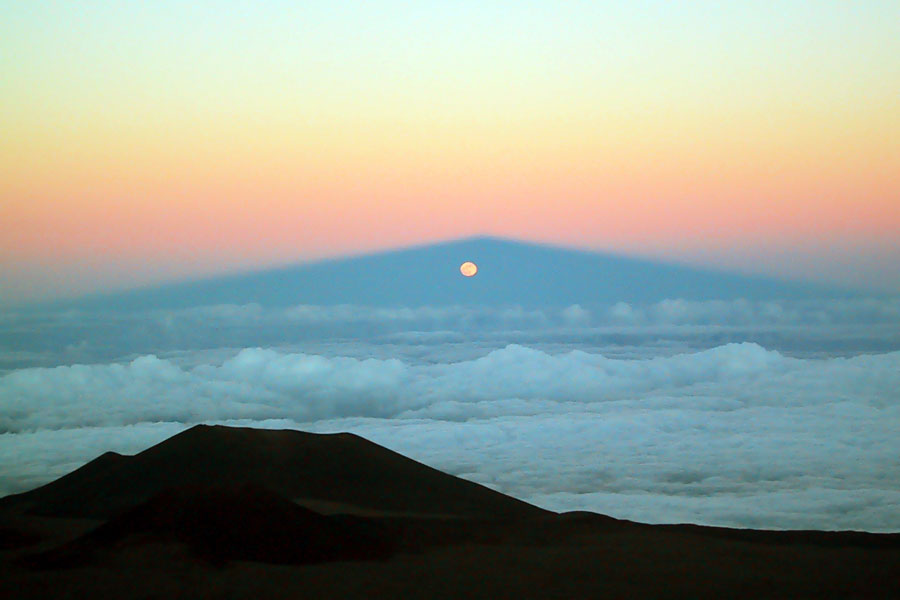
Moonrise Through Mauna Kea's Shadow (Dec. 5 2010)

                    Seeing this photo may make one ask, how can the moon be rising in front of a mountain? It cannot, what is happening in this photo is a moon rise through the shadow of a large volcano. The volcano is Mauna Kea in Hawaii, USA, a frequent spot for breathtaking photographs because it is an extraordinary place on Earth for many reasons. The Sun in this photo just set in the opposite direction, behind the camera. Also, the Moon has just passed its full phase, were precisely at its full phase it would rise, possibly eclipsed, at the shadow's peak. Refraction of moonlight through the Earth's atmosphere makes the Moon appear slightly ovular. Steep conically shaped hills of volcanic fragments from old volcanic eruptions are visible in the foreground. Cloud tops below Mauna Kea's summit have unusually flat tops, which indicate a decrease in air moisture that frequently keeps the air unusually dry.

APOD 2.5


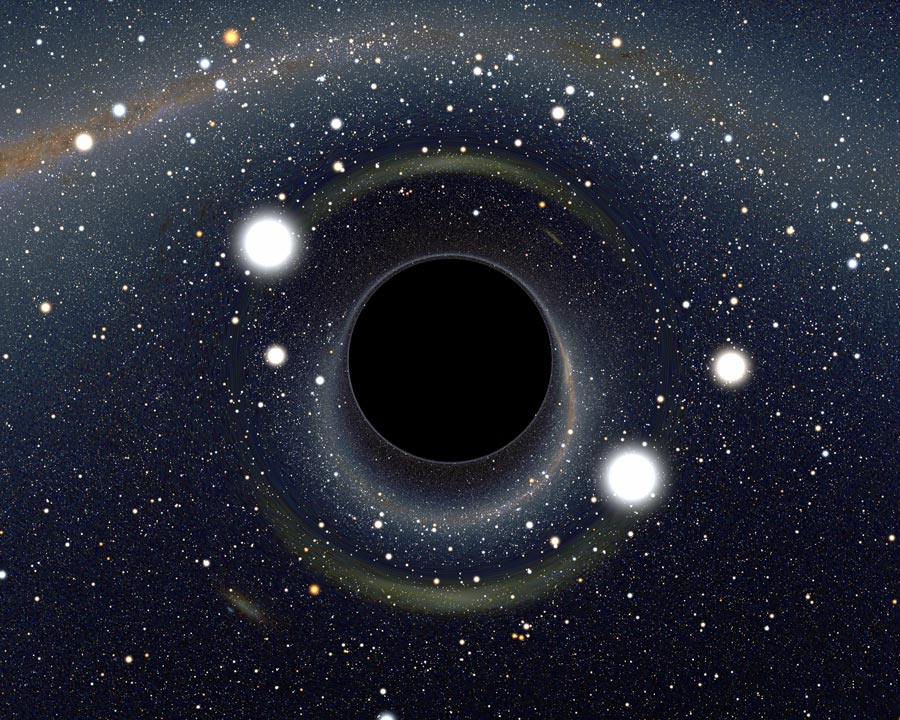
Too Close to a Black Hole (Dec. 7 2010)

            What do you think you would see if you looked directly up to a black hole? Pictured above is a computer generated image modeling how strange it would look. The black hole has such a strong gravitational pull that light actually bent towards it which causes some very unusual visual distortions. Every star in the regular frame has at least two bright images, one on each side of the black hole. Near the black hole, you can see the whole sky because light from every direction is bent around and returns back to you. The original background image was taken from the 2MASS infrared sky survey, including stars from the Henry Draper catalog superposed. Black holes are considered to be the densest state of matter, and there is indirect evidence for their existence in stellar binary systems and the centers of globular clusters, galaxies, and quasars.