Thursday, October 28, 2010

APOD 2.1


M57: The Ring Nebula (Nov. 15 2009)

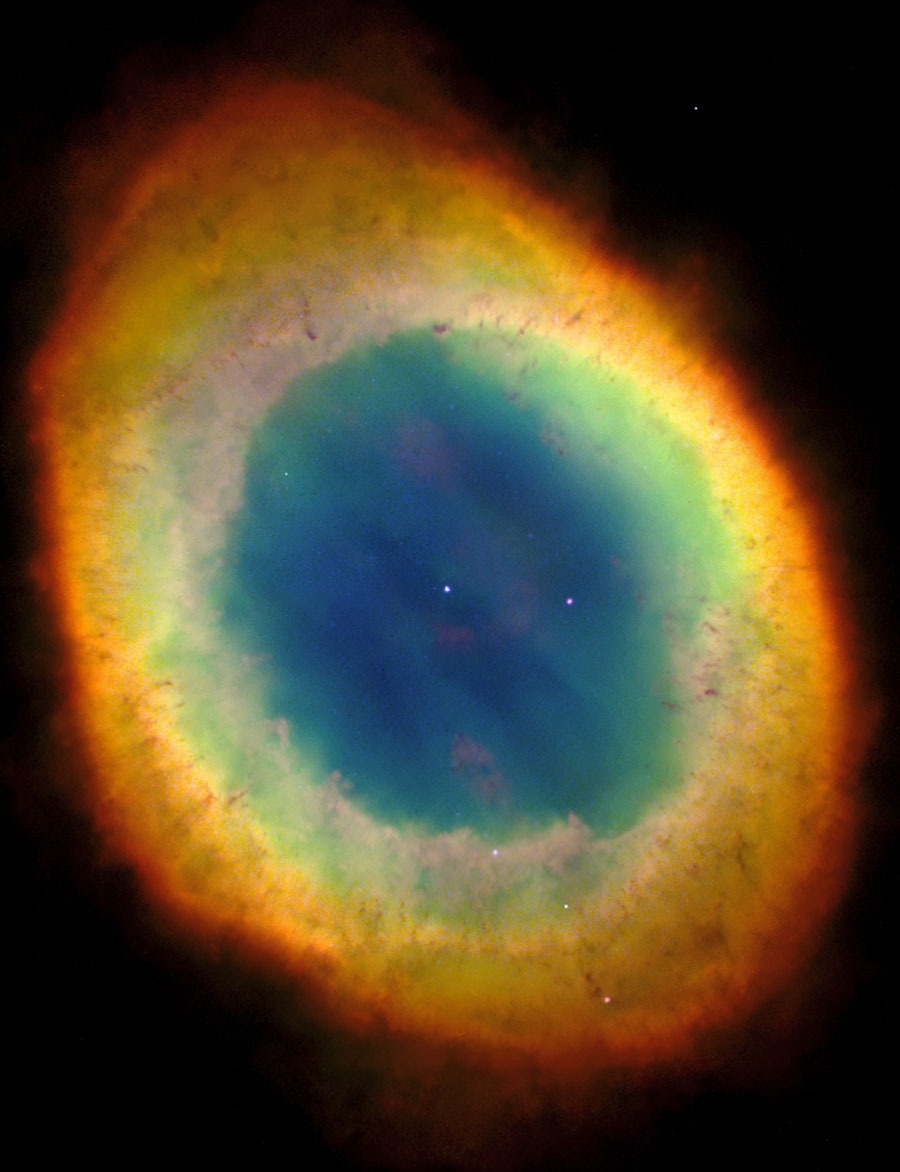
           M57, the Ring Nebula, looks to most astronomers like a ring in the sky hence its name. I agree with that statement but I personally think it looks more like some sort of geothermal spring in which the color comes from pigmented bacteria which strive in the mineral rich water. It is now known to be a planetary nebula which is a gas cloud emitted at the end of a Sun-like star's existence. As one of the brightest planetary nebula on the sky, the Ring Nebula can be seen with a small telescope in the constellation of Lyra. The Ring Nebula is about 4,000 light years away, and is nearly 500 times the diameter of our Solar System. In this picture taken by the Hubble Space Telescope in 1998, dust filaments and globules are visible far from the central star. This helps indicate that the Ring Nebula is not spherical, but cylindrical.

Friday, October 22, 2010

APOD 1.8


Rigel and the Witch Head Nebula (Dec. 29 2009)

I found this nebula to be interesting and whimsical because like its name, the Witch Head Nebula, it really does look like a witches' head. It is a reflection nebula which are clouds of dust that are simply reflecting the light of a near by star, in this case, the star is Rigel. Rigel is the brightest star in the constellation Orion and the sixth brightest star in the sky. Fine dust in the nebula reflects the light. Pictured above, the blue color of the Witch Head Nebula and of the dust surrounding Rigel is caused not only by Rigel's blue color but because the dust grains reflect blue light more efficiently than red. The same physical process causes Earth's daytime sky to appear blue, although the scatterers in Earth's atmosphere are molecules of nitrogen and oxygen. Rigel, the Witch Head Nebula, and gas and dust that surrounds them lie about 800 light-years away. The Witch Head Nebula is also known as IC 2118.

Friday, October 15, 2010

Ole Roemer Bio

                Ole Roemer was a Danish astronomer who was born in Arhus, Denmark on Sept. 25 1644. He first enrolled in the University of Copenhagen in 1662, in which he had a mentor, Rasmus Bartholin, who published his discovery of the double refraction of a light ray by Iceland spar in 1668 while Roemer was living in his home. Roemer was given endless opportunities to learn mathematics and astronomy using Tycho Brahe's astronomical observations, since Bartholin had been given the responsibility of preparing them for publication. 
                In 1681, Roemer returned to Denmark and was appointed professor of astronomy at the University of Copenhagen, and the same year he married Anne Marie Bartholin, Rasmus' daughter. He was an active observer, both at the University Observatory at Rundetårn and in his home, using improved instruments of his own construction. Unfortunately, his observations did not survive because they were lost in the great Copenhagen Fire of 1728 which was the largest fire in the history of Copenhagen. Luckily his assistant, Peder Horrebow, loyally described and wrote about Roemer's observations.
              While Roemer held the position of royal mathematician, he introduced the first national system for weights and measures in Denmark on May 1 1683. Initially based on the Rhine foot, a more accurate national standard was adopted in 1698. Soon after this in 1700 Roemer managed to get the king to introduce the Gregorian Calender in Denmark and Norway, something that Tyco Brahe unsuccessfully argued decades ago. Roemer also developed one of the first temperature scales. Fahrenheit visited him in 1708 and improved on the Rømer scale, the result being the familiar Fahrenheit temperature scale which is still used today in some countries. Roemer also established numerous navigation schools in Danish cities. In 1705, Roemer was made the second Chief of the Copenhagen Police, a position he kept until his death in 1710. As one of his first acts, he fired the entire force, because he was convinced that the morale was alarmingly low. He was also the inventor of the first street lights in Copenhagen, and maintained social order within. This was the start of a social reform. In Copenhagen, Roemer made rules for building new houses, got the city's water supply and sewers back in order, ensured that the city's fire department got new and better equipment, and was the moving force behind the planning and making of new pavement in the streets and on the city squares.
            Among all of Ole Roemer's accomplishments and contributions to his city, his most noted achievement was being the first person to quantify the speed of light. By 1675 Roemer was 31 and working in Paris with Jean Picard. He was interested in the movement of Jupiter's nearest moon. He tracked it as it orbited in and out of Jupiter's shadow. It entered the shadow, then reemerged 42 hours, 28 minutes, and 35 seconds later. It moved with metronomic regularity. In one hundred transits, Jupiter's moon could be relied on to emerge once more, right on schedule. Six months and 100 laps later, Roemer set his clock and focused his telescope on Jupiter. Minutes passed but there was no moon for him to observe. About 15 minutes later Roemer presumably theorized what was happening. Earth had swung hundreds of millions of miles away from Jupiter during the long winter months. Light had to travel that vast distance. It'd obviously taken the extra time to do so. He put pencil to paper and concluded that light had to move 192,500 miles per second to lose just fifteen minutes. Roemer was within three percent of the right value. Which was only about 70 years after telescopes made it onto the scene. 
             Overall it is apparent that Ole Roemer had an impressive impact on not only his own community and society but for the rest of the world up to the present. His achievements have earned him much recognition and awards such as a plaque at the Observatory of Paris which commemorates what was, in effect, the first measurement of a universal quantity made on this planet. There is also an Ole Roemer Museum on the island of Zealand in Denmark which contains the works and observations of Roemer and contains a large collection of ancient and more recent astronomical instruments.


Thursday, October 14, 2010

APOD 1.7


NGC 7331 (Oct. 22, 2010)

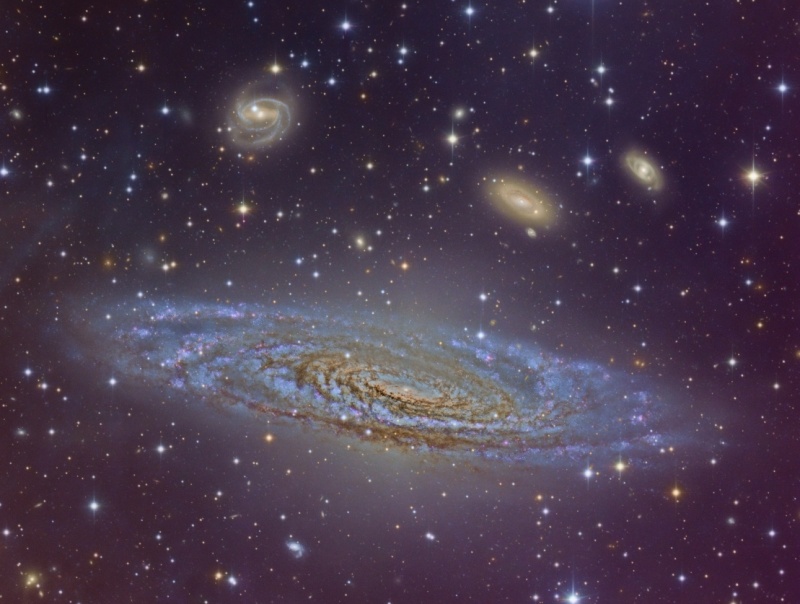
            This big beautiful spiral galaxy, NGC 7331, is a target for astronomers and is one of the brighter galaxies not found in Charles Messier's famous eighteenth century catalog. About fifty million light-years distant in the northern constellation Pegasus and similar in size to our own Milky Way Galaxy, NGC 7331 is often imaged as the foundation of a visual grouping that includes an intriguing assortment of background galaxies about ten times farther away. This astounding image of the well-studied island universe and environs was created by using data from the Calar Alto Observatory in southern Spain. Perhaps the deepest view of the region yet, the image data were processed to reveal sharp details of all sizes in both bright and faint areas. A color balance was chosen so that white would be the result of averaging colors over the entire galaxy. The result shows off a numerous amount of remarkable features in NGC 7331 and its surroundings.

Friday, October 8, 2010

APOD 1.6

http://apod.nasa.gov/apod/ap101002.html


Hubble's Lagoon (Oct. 2, 2010)
  
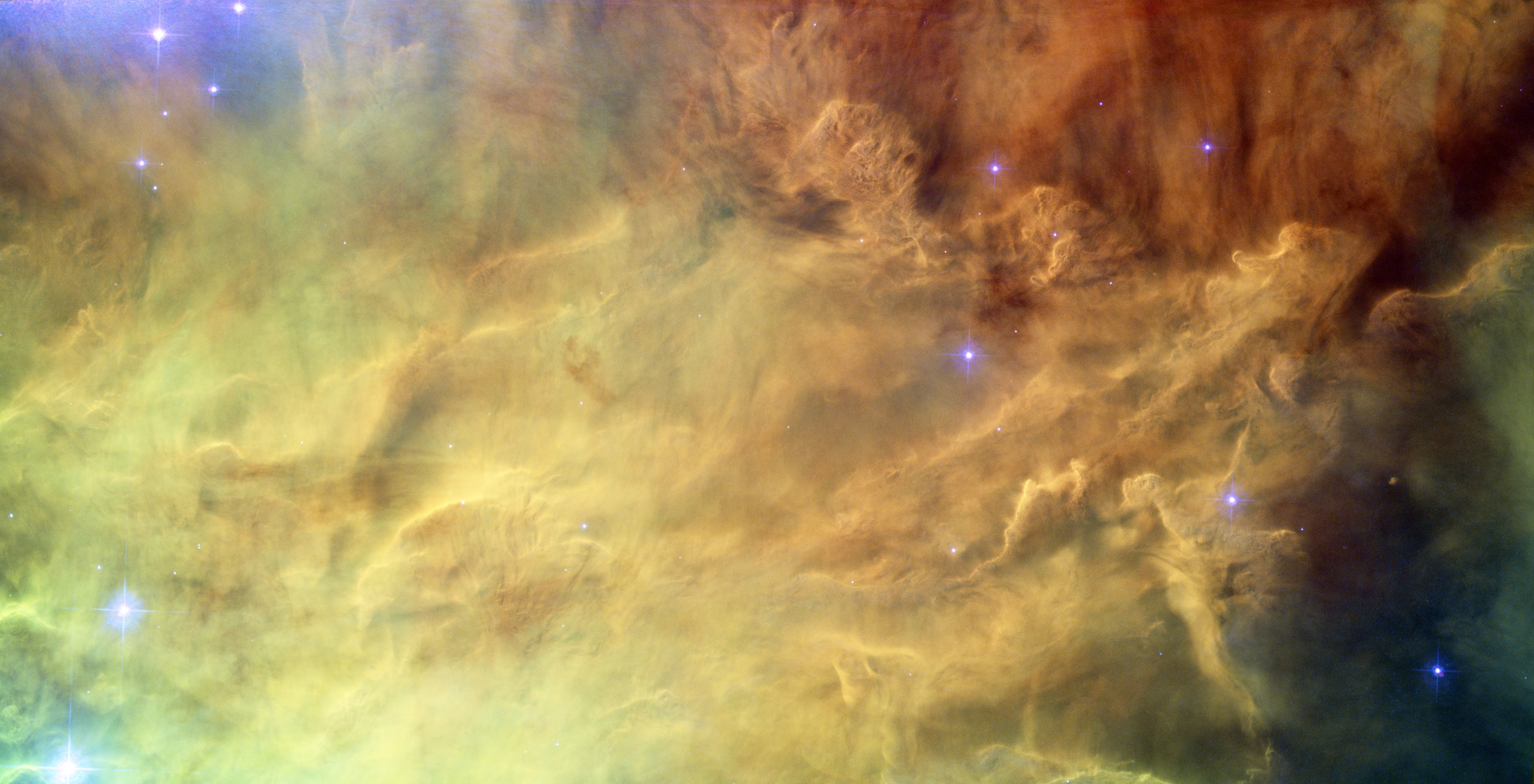
This image is of M8, or the Lagoon Nebula. As stated in the article, the dust clouds appear as brush strokes on a canvas except in this case, the canvas is nearly three light years wide. The colors map emission from ionized gas and was recorded by the Hubble Telescope's Advanced Camera For Surveys. The Lagoon Nebula is a star forming region about five thousand light years distant from Sagittarius. This sharp and close up view is remarkable because it allows us to see undulating shapes sculpted by the energetic light and winds from the region's new born stars. It becomes apparent to me that the Lagoon nebula is a popular target for earthbound sky gazers, too. This is because it features a prominent dust lane and bright hourglass shape in small telescopes with wider fields of view.

Observations 2

Monday (Oct. 4, 2010):  At 8:10 PM I observed an iridium flare NNE in the sky.

Tuesday (Oct. 5, 2010): At 8:05 PM I observed another iridium flare NNE in the sky.


Thursday (Oct, 7 2010): At 7:10 AM I observed the New Moon in the North.


Friday, October 1, 2010

APOD 1.5


The Hubble Ultra Deep Field (March 9, 2004)

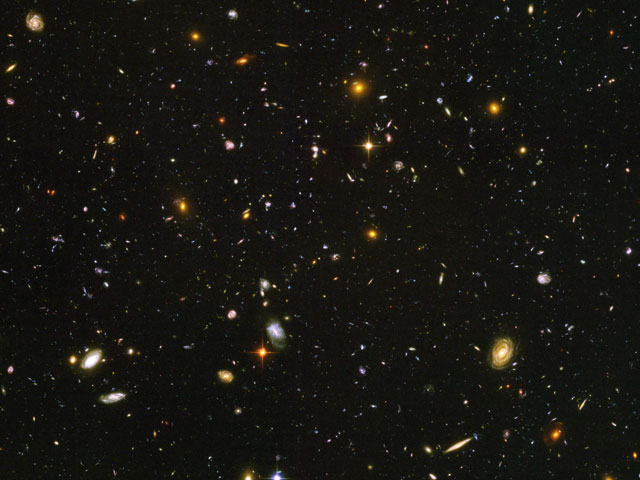
The image above was taken by the Hubble Ultra Deep Field (HUDF) and it it is the deepest portrait of the visible universe ever achieved by humankind. the million-second-long exposure shows the first galaxies that emerged from the so called "dark ages," which was the time shortly after the big bang when the first stars reheated the cold, dark universe. This "dark age" was about thirteen billion years ago, which is only five percent of its current age. The image is actually two separate images taken by Hubble's Advanced Camera for Surveys and the Near Infrared Camera and Multi-object Spectrometer. After staring for about three months at the same spot, this new HUDF is four times more sensitive in most colors than the original Hubble Deep Field (HDF). This is extremely interesting because scientists have had the ability to study this image for years now and come up with better ways to understand how stars and galaxies formed in the earlier universe.