Thursday, September 30, 2010

Ole Roemer

Ole Roemer

Soter, Steven. “Ole Roemer and the Speed of Light.” American Museum of Natural History. Web. 30 Sept.                                          2010. (http://www.amnh.org/education/resources/rfl/web
essay books/cosmic/p_roemer.html)

“Ole Roemer.” 1911 Encyclopedia Britannica. Web. 01 Oct. 2010. (http://www.1911
Encyclopedia.org/ole_roemer)

Friday, September 24, 2010

APOD 1.4

http://apod.nasa.gov/apod/ap050425.html


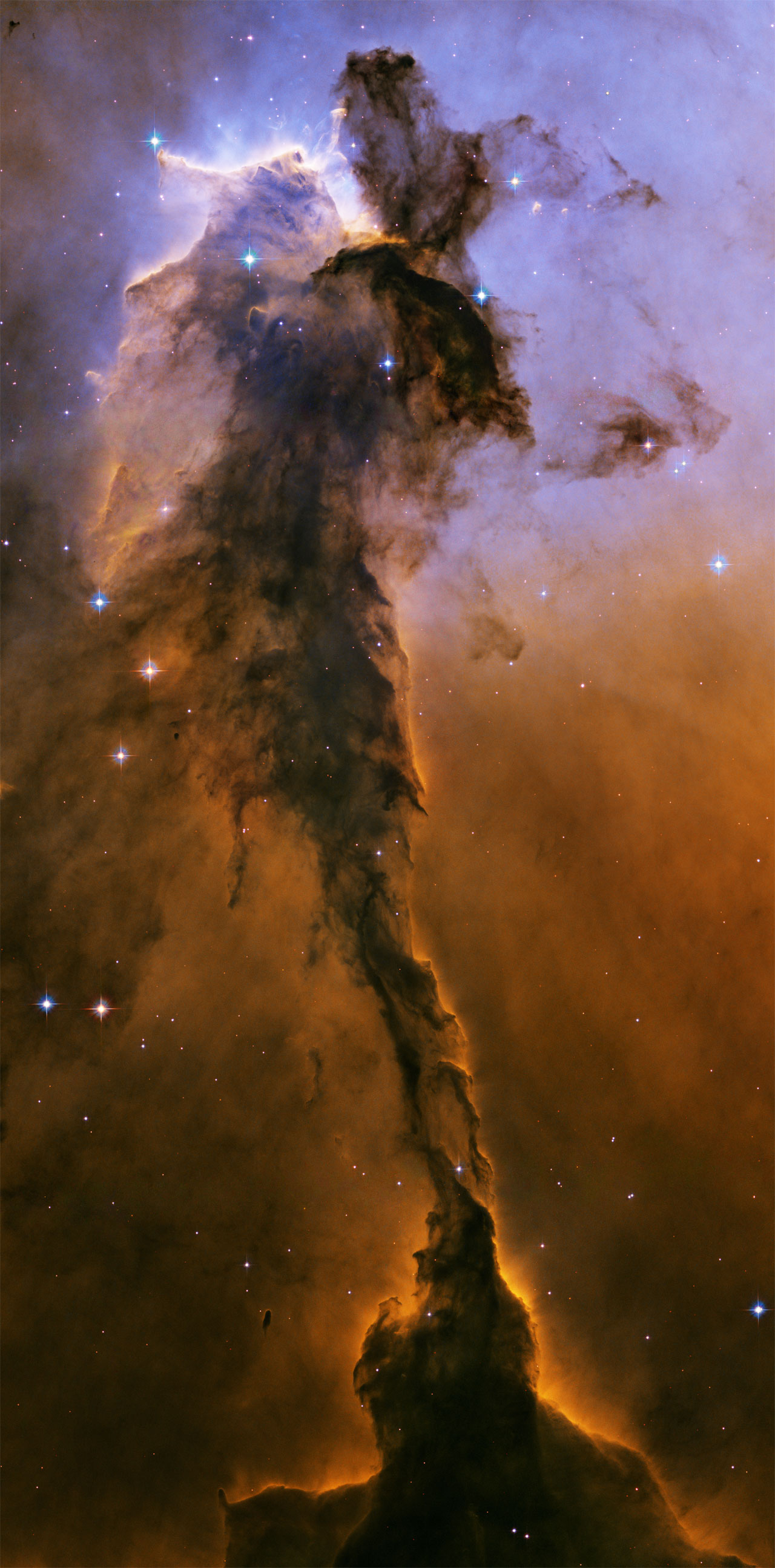
The Fairy of Eagle Nebula (April 25, 2005)

                    This is one of several striking dust pillars of the Eagle Nebula that seems to be a gigantic alien fairy. The dust sculptures of the Eagle Nebula are in the stages evaporating. Since powerful starlight whittles away these cool cosmic mountains, the statuesque pillars that remain can be imagined as mythical beasts or something of that sort... use your imagination. This fairy, however, is ten light years tall and spews radiation much hotter than the common fire we experience. The greater Eagle Nebula, M16, is a massive evaporating shell of gas and dust inside of which is a growing cavity filled with a spectacular stellar nursery currently forming an open cluster of stars. This image was developed in scientifically re-assigned colors and was released as celebration for the 15th year anniversary of the Hubble Telescope.

Wednesday, September 22, 2010

Observations 1

Monday (9/20) - Around about 9:00 PM I observed that Jupiter was rising in the east near the moon


Tuesday (9/21) - Also at about 9:00 PM I observed that the moon was in the east and Venus was in

the west.


Wednesday (9/22) - The moon is a full moon today. There is also minimum serperation between the

moon and Jupiter which is about 3 degrees.

Thursday, September 16, 2010

APOD 1.3


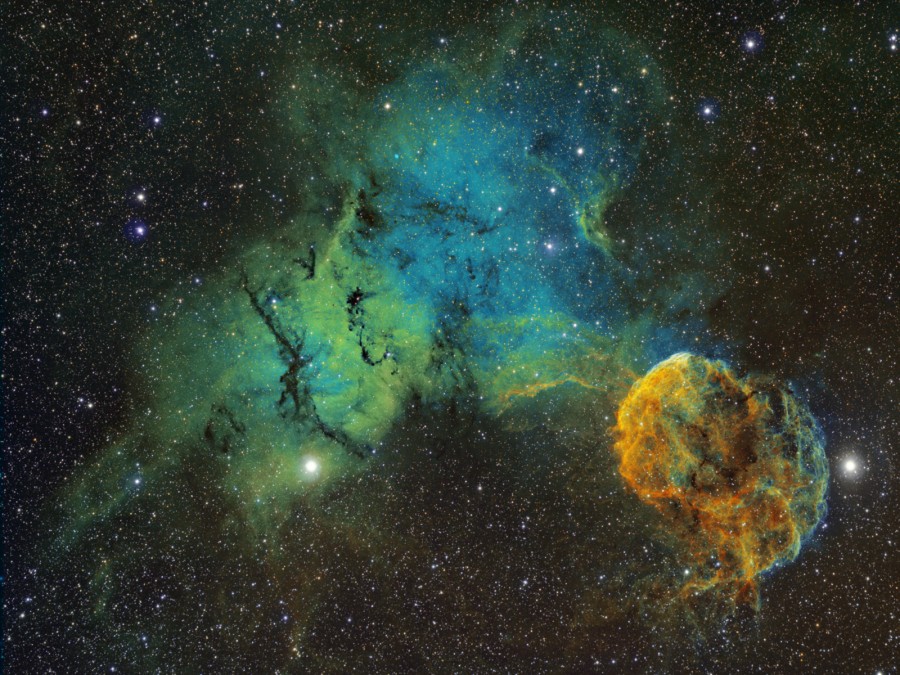
The Elusive Jellyfish Nebula (May 15, 2010)

                      In this picture the colors have been enhanced to make the nebula more noticeable which I found interesting because the Jellyfish Nebula is rather faint and elusive in reality. Flanked by two bright stars, Mu and Eta Geminorum, at the foot of a celestial twin, the Jellyfish Nebula is the brighter arcing ridge of emission with dangling tentacles below and right of center. It is also interesting that the cosmic jellyfish is seen to be part of bubble-shaped supernova remnant IC 443, the expanding debris cloud from a massive star that exploded. Light from the explosion first reached planet Earth over 30,000 years ago. Like its cousin in astrophysical waters the Crab Nebula supernova remnant, IC 443 is known to harbor a neutron star, the remnant of the collapsed stellar core. Emission nebula Sharpless 249 fills the field at the upper left. The Jellyfish Nebula is about 5,000 light-years away. At that distance, this image would be about 300 light-years across. The color scheme used in the narrowband composite was made popular in Hubble Space Telescope images, mapping emission from oxygen, hydrogen, and sulfur atoms to blue, green and red colors.

Friday, September 10, 2010

APOD 1.2


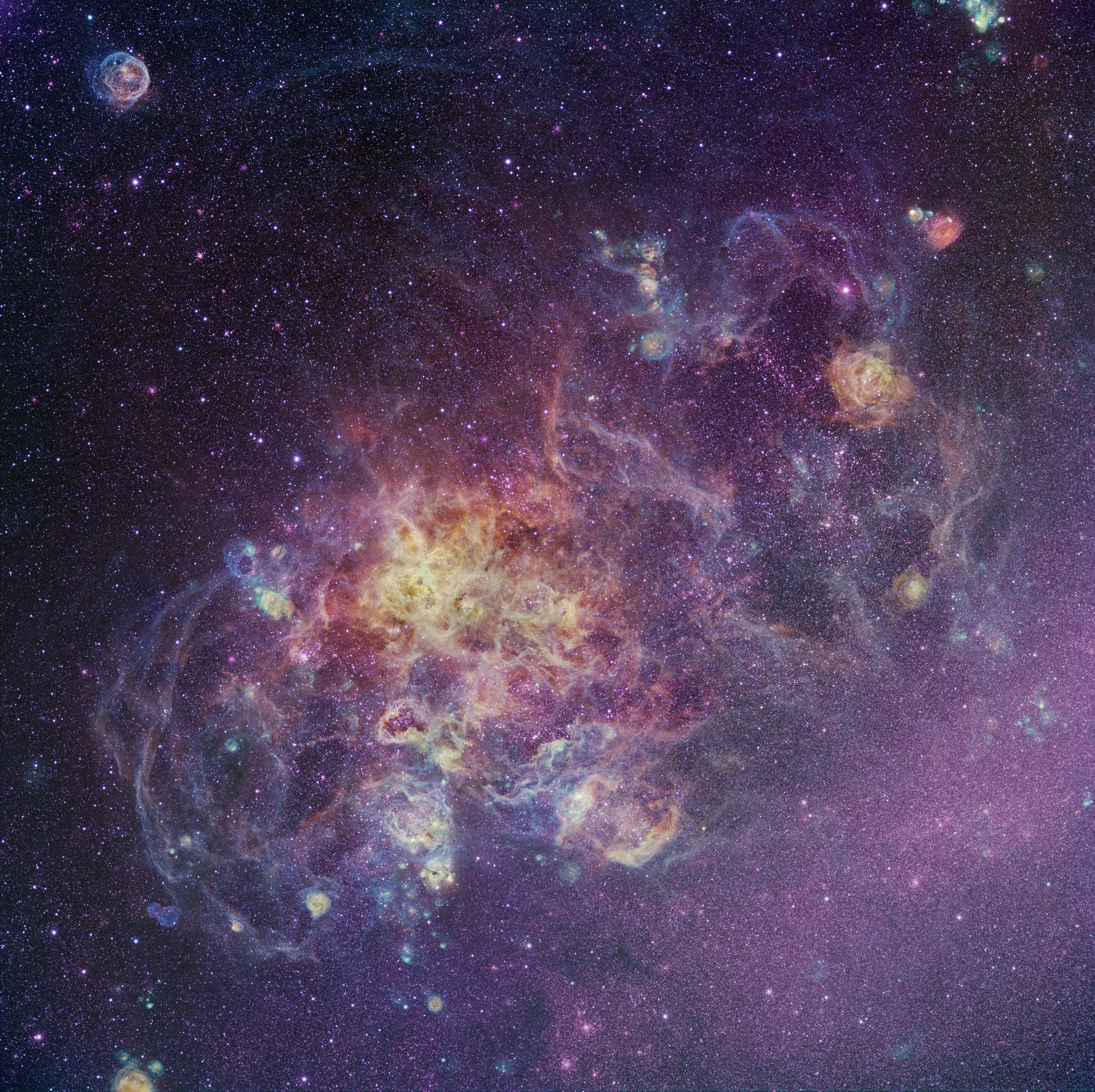
The Tarantula Zone (Sept 1, 2009)

              The Tarantula Nebula is a giant (more than 1,000 light years in diameter) star forming region within our nieghboring galaxy the Large Magellanic Cloud. Within the Tarantula, intense radiation, stellar winds and supernova shocks from the central young cluster of massive stars, cataloged as R136, energize the nebular glow and shape the spidery filaments. Around the Tarantula are other violent star-forming regions with young star clusters, filaments and bubble-shaped clouds. The rich field is about as wide as the full Moon on the sky, located in the southern constellation Dorado.  It was recognized to be a nebula by Abbe Lacaille on December 5, 1751.

Right Ascension 05 : 38.7 (h:m)

Declination -69 : 06 (deg:m)


Distance 179.0 (kly)


Visual Brightness 8 (mag)


Apparent Dimension 40 x 25 (arc min)

Monday, September 6, 2010

APOD 1.1


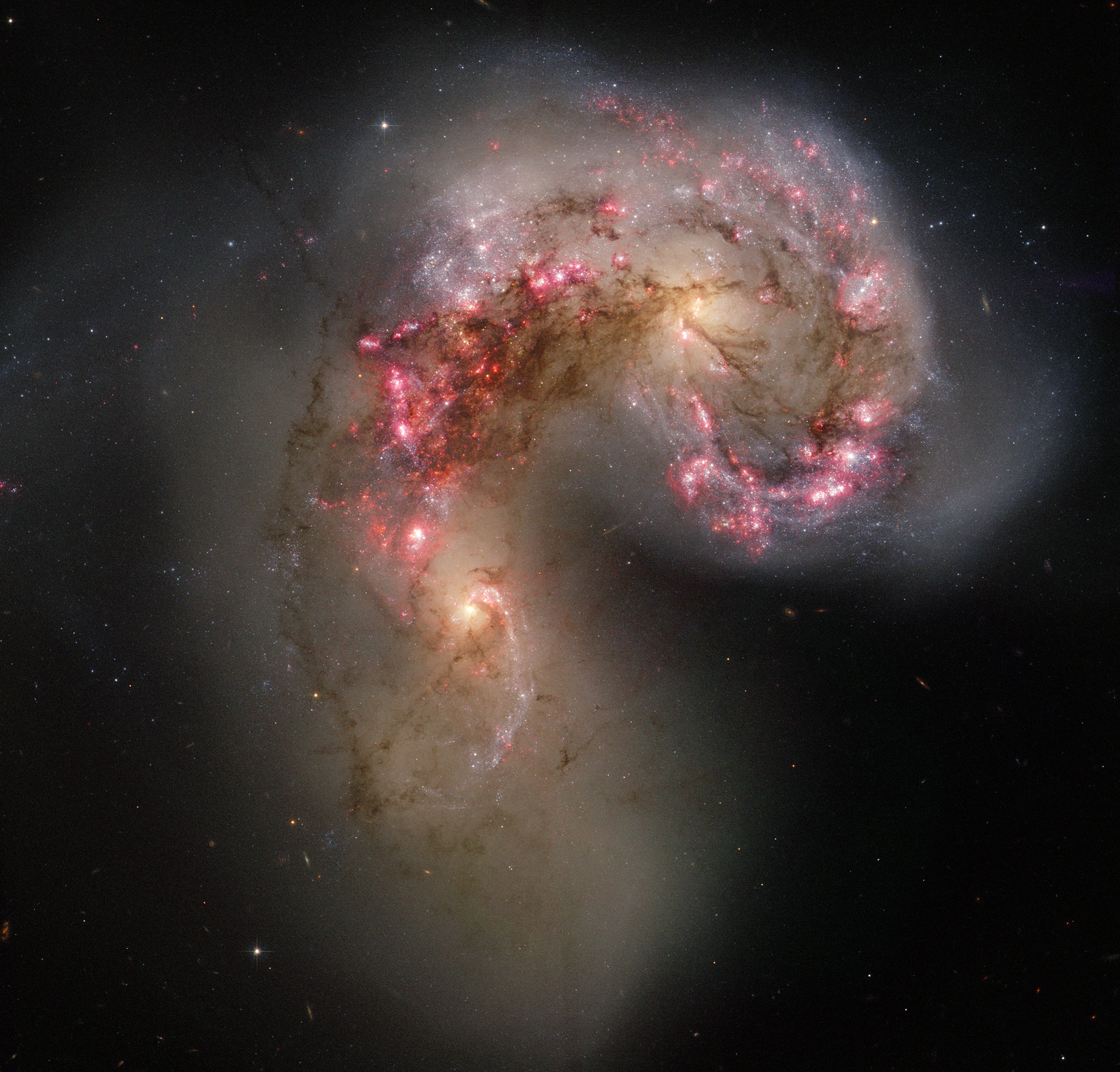
The Antennae Galaxies in Collision (July18, 2010)


        The two galaxies are squaring off in Corvus which is a constellation in the southern hemisphere that is named for the crow, a bird associated with Apollo. It looks nothing like a crow but was named this because it was near the constellation Hydra. The probability of two stars within the galaxies colliding is almost 0. This is because even though there are an incredibly large number of stars in the galaxies, the density of stars is not very big since the galaxies are extremely big. In other words, the sizes of the stars are very small compared to the average distance between them. What can happen is that the large quantities of dust and gas within the galaxies can interact gravitationally. Also the galaxies can pull on the material in the other galaxies and disrupt their morphologies. There is also friction between the gas in the colliding galaxies, causing shock waves that can trigger some star formation in the galaxies. For example, two spiral galaxies can merge to form an elliptical galaxy.